



With the PMO announcing its intent to recognize a Palestinian state in September, CIJA has two action items for those who wish to voice their concern that the Prime Minister is breaking with established Canadian foreign policy. You can add your voice to the first statement HERE, intended for Prime Minister Carney, and utilize the action hub to contact your MP by clicking HERE.
Additionally, on Wednesday, the Toronto International Film Festival cancelled its invitation for filmmakers to screen “The Road Between Us: The Ultimate Rescue” at the festival. The film, created by Canadian filmmaker Barry Avrich, tells the story of Noam Tibon, a retired IDF general. Tibon and his allies made heroic sacrifices to save his son and family from their home on Kibbutz Nahal Oz on October 7th. You can learn more about this incredible story here.
Thursday, after an outpouring of support for the creators of the film and bafflement with TIFF, the festival reversed course. This is a clear win for the advocacy work our community has built over the last few years. You can read complete coverage here. To those of you who signed petitions and contacted TIFF on Wednesday, Kol haKavod!
Learn more about Advocacy@HBT here.
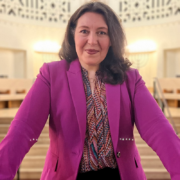
Holy Blossom Temple President from 1986-1988
 Today, the fullness of the life of Fred Zemans emerges again for us to honour and celebrate. Today, we reassign the dignity and esteem to the man, who earned it — mitzvah by mitzvah, small, sacred deed by small, sacred deed.
We learn about this accumulation of the small things from Rabbi Leo Baeck, who is remembered here in stained glass as he is remembered through the namesake of the Reform Jewish Day School, which Fred helped to establish. Baeck wrote: “Piety, especially Jewish piety, respects the little – the little person, the little matter, the little task, the little duty. Through the little, religion meets the greatness that lies behind.”
Fred understood this. The small conversation with a grandchild wasn’t small at all – it will be remembered forever. The small piece of advice given to a law student wasn’t small at all – it set the trajectory of a career. The small words Fred strung together to express big ideas took hold and shaped this country of Canada, which he loved. Those little words and big ideas took hold in far-off countries, too.
So let us learn from Fred to set our deeds to scale. To let the small devotions be magnified, to let the small mitzvot multiply, to let the small gestures of kindness accumulate into a lifetime of great and far-reaching impact.
We can also learn from the kind of Jew that Fred Zemans was. Fred was a Jewish particularist. He loved his people. He felt responsible for the Jewish People. He learned Jewish leadership from the living examples set by his parents and grandparents in Calgary, founders of the synagogue, leaders of Hadassah and the National Council of Jewish Women. Fred walked in their footsteps. His rabbis became his friends. Fred was so proud of the growth of the Leo Baeck Day School. I remember how he would well up every time he spoke of it. Fred served as the President of Holy Blossom Temple from 1986-1988, and he gave counsel to many Temple Presidents who succeeded him.
Fred’s Jewish particularism was matched by his Jewish universalism. He loved his people, and out of his love for the Jewish People, his love for all people grew. Out of his love for the Torah-wisdom that teaches how all people are created in the image of God, Fred devoted himself – personally and professionally – to protecting the human dignity of every human being. He attached himself to the whole; felt responsible for those beyond the sphere of his own people.
So let us learn from Fred how to devote ourselves to our own people fully and how to – simultaneously – devote ourselves to other peoples fully. Fred showed us that we don’t have to choose. Life does not have to be seen as a series of “either/or” decisions and devotions. If we will it, life can be met with: “yes/and.” Fred Zemans showed us that with hard work, with an open heart and a good mind, we can meet this broken world with a full commitment to those who are close and to those who are far, to those who are just like me and to those who are not like me, but are nevertheless, part of my human family.

By Mair Musafija
*Fred Zemans 1938-2025
 I will attempt to outline a few snapshots of our Canadian life with Fred, our true friend, and our Canadian father and grandfather. Gentle and talkative, with boyish gestures, he always filled the room with his thoughts, often accompanied by laughter and, more frequently, tears of joy. His speeches about his wife, children, and friends were filled with admiration for their life achievements. His words were often intertwined with tears as they brought our circle closer, with Fred’s heart at its center.
We met soon after our arrival in November 1992. On Fred’s recommendation, I was invited to speak about the war in Bosnia and Herzegovina during an evening at Holy Blossom, hosted by Rabbi Marmur. I remember that the Jewish family who arrived at the same time as we did were invited to different synagogues, but Holy Blossom Temple felt like the right fit for many. In our case, Joyce and Fred were the primary reasons this place felt so welcoming. Later on, during the High Holidays, seeing Fred called to the bimah as the past President of Holy Blossom Temple was a highlight of these special days in the synagogue. The time to break the fast was always very special in the busy Zemans family home, filled with people, young and old, Jews and non-Jews, rich and poor, who would dress up for the occasion. I always felt that these occasions were moments of stepping up to the world, to a very special Canadian stage. Looking back, I admire Fred’s and Joyce’s effort to never forget to invite us. These invitations were our visa to a better life.
When Simeon was born in 1993, Fred came to congratulate us and told me that I was a rich man, blessed with three sons and a beautiful wife. As paradoxical as it sounded back then, it proved true, as we find ourselves surrounded by young people, their partners, and my grandchildren today. According to Fred, true wealth meant being surrounded by family and friends. My wife and I viewed Joyce and Fred as a model couple who built their world around them. People from all walks of life consistently showed their respect and affection toward the Zemans’ family, and we were fortunate to be included in their circle. We rubbed shoulders with their friends and family—from the Premier of Ontario to helpers in their kitchen, senior rabbis, well-known publishers, and famous sculptors—just two refugees from the war-torn country of Yugoslavia.
On the occasion of Fred’s retirement, I remember a colleague remarking that Fred was a law scholar rather than a lawyer. It may be true, but in my life, he played the role of a lawyer. In one of my gigs, I almost got stiffed for a thousand dollars by the boss, who withdrew deductions from my salary, but when the time came, these deductions were nowhere to be found on my pay records. It looked hopeless, and I asked Fred what to do. He promptly offered to talk to the boss on my behalf. I passed it to the boss, who was surprised that I could get the lawyer so quickly. Fred called him and they talked briefly. The mission was accomplished—things turned in my favour. I felt empowered, almost as if I had money to pay the “true” lawyer.
 Fred’s mission was to uplift and empower those he believed deserved a fair chance in life. The privilege he was born into was not something he wished to keep only for himself; instead, he dedicated himself to “tikkun olam”—repairing the world. This mission is an endless journey, just like the warmth of Fred’s presence in our lives, which will stay with us until our own lives come to an end.
Zichrono Livracha, my dear Fred!

We have reached the last month of our calendar and the most sacred. Elul is the sixth month of the Jewish year (counting from Nisan), which immediately precedes Rosh Hashanah. It is traditionally a month of introspection and stocktaking – a time to review one’s deeds and spiritual progress over the past year and prepare for the upcoming “Days of Awe” of Rosh Hashanah and Yom Kippur. The word “Elul,” aleph, lamed, vav and lamed, is an acronym for the phrase (from the biblical Song of Songs) ani l’dodi v’dodi li, which means “I am to my beloved and my beloved is to me.”
Believing that the “beloved” refers to God, the sages take this verse to describe the particularly loving and close relationship between God and Israel. During Elul, then, is our time to establish this closeness so that we can approach the Yamim Noraim, or Days of Awe, in trusting acceptance of God’s judgment. We approach the trial not out of fear, but out of love. As the month of “Divine Mercy and Forgiveness”, it is a most opportune time for teshuva (“return” to G-d), prayer, charity, and increased “Ahavat Yisrael” (love for a fellow Jew) in the quest for self-improvement and coming closer to G-d.
The letter of the month is yud, which signifies action. It is the smallest letter in the alphabet, alluding to humility. Therefore, the attribute of the month is ACTION. Teshuva is a state of mind, but it is not enough without action. As it is said, we first do and then we will understand.
“May you be inscribed and sealed for a good year” (L”shanah tovah tikateiv veteichateim)
We hope you will join us for our Rosh Chodesh Elul Service on Sunday, August 24, at 9:00 am.
All genders are welcome to join Women of Holy Blossom and pray in solidarity with Israel’s Women of the Wall. Join Women of Holy Blossom in sacred worship for Shacharit services followed by a light breakfast. Learn more & join us here!
by Sheila Smolkin
 One of the many things I have come to appreciate while working on the Temple Archives is the tremendous contribution various women in the congregation have made to the development of our synagogue over the years. One of those women is Marilyn Farber, a true Woman of Valour.
Marilyn attributed her mother, Sadie Danson, with imbuing her with a feeling of pride in the family’s long association with Holy Blossom, an association that dates back to the Richmond Street days. (Holy Blossom built its first home on Richmond Street in 1876 and occupied that space for the next 21 years.) Two of her aunts were members of the first Confirmation class of 1899, a class designed especially for young girls.
Marilyn followed her mother by becoming very involved in Sisterhood (now Women of Holy Blossom) and eventually became President of Sisterhood from 1961 to 1963. Her page in Sisterhood’s Women of Valour Book lists her accomplishments as a Vice-President of the Parent Council, a founder of Holy Blossom Alumni (an early seniors’ group at Temple), the formation of the Fine Arts Committee, and the creation of Oneg Shabbat following Friday night services.
The Archives is fortunate to have several memories written by Marilyn of her years at Temple, as well as a video interview done by Michael Cole a few years before Marilyn’s death. These pieces bring Temple activities to life, and Marilyn’s friendship with key Temple personnel like Rabbis Eisendrath, Feinberg, and Plaut, as well as Edmund Scheuer, who was considered the father of Canadian Reform Judaism, paints a wonderful picture of just who these leaders really were.
After her stint as President of Sisterhood, Marilyn joined the Temple Board of Trustees and was elected as recording secretary, the first woman to serve as an officer of the congregation. She was named a Warden of the Congregation in the 1980s. Marilyn could very well have gone on to be the first woman president of the congregation except for the fact that when the Chair of the Nominating Committee phoned to offer her the position, her husband, Earl, answered the phone and turned down the request!
One of my favourite passages in the Temple’s Board Minutes is an excerpt of the very long and heated discussion surrounding the issue of allowing liquor to be served at Temple simchas. Up until this point, the only liquor on Temple grounds was wine for Kiddush. But this was the early 1960s, and the Philip Smith Hall had just been completed. The hope was that Temple members would use this facility for functions. Max Enkin and Bora Laskin were both against loosening the rules concerning alcohol and suggested that all sorts of evil activities could follow. The Board Minutes have a simple line attributed to Marilyn where she is reported as saying, “I don’t think that would happen!”
Marilyn’s two brothers, Barney Danson (former Minister of National Defense of Canada) and Bert Danson were members of Temple as well. Some may remember the Danson family as being the original owners of Camp Winnebagoe. Marilyn’s two children, Janie and Ronald, grew up at Temple and Janie, with her husband, Frank Tizel, are still members of Holy Blossom Temple.
I consider myself to be so fortunate to have known Marilyn. From her, I learned true leadership qualities and how to fight for your values in all you do.
Marilyn was indeed a Woman of Valour.

By Mikhael Klassen-Kay, HBT Archives Summer Intern
Over the past couple of months, I’ve had the pleasure of working with Holy Blossom’s archives committee as they digitally catalogue all of the files contained in the temple archives, which date from the early 19th century to the present day. On several lunch breaks spent meandering the hallways of the temple, I came across objects discussed in the files I was cataloguing. Many congregants will be familiar with the orange parochet outside the first-floor boardroom, which is believed to have hung in the original Holy Blossom location above Coombes’ Drug Store, when the synagogue was called Sons of Israel. Others might have noticed Sorel Etrog’s “Chasidic Head” statue, originally part of a Holocaust memorial in the courtyard prior to the building renewal, which is now stationed in the grass on the Bathurst side of Holy Blossom. Most of the archival materials on these objects, however, were photographic or textual. So, the discovery of fabric samples and textile blueprints in the archives took me by surprise.
In section HB3 D1b of the Holy Blossom archives, one can find blueprints, letters, and textiles created by the late artist Temma Gentles. The projects of hers that we have archival documentation of include Torah covers, ark textiles, a chuppah, and pulpit covers. Unlike in the chuppah and Torah mantle files in the archives, there are no fabric samples for the pulpit covers. As Gentles explains in a letter to Estelle Latchman, who was chairman of Holy Blossom’s art and acquisitions committee in 1990, the fabric needed for the project was too expensive to justify the creation of a sample textile. Instead, Gentles provided the art and acquisitions committee with a layered art piece as a sample of what the finished product would look like. The drawn sample is for the cover of the Torah pulpit, featuring the first line of Psalm 100:3.
 Each of the three finished tapestries depicts four figures rejoicing, with the Hebrew text from a fragment of Psalm 100 overlaid. In a December 1989 letter to Rabbi Dow Marmur, Gentles cites the psalm as the primary inspiration for the pulpit covers. She uses the following translation of verse two and the first line of verse three—“Serve the Lord with gladness! Come into His presence with singing! Acknowledge that the Lord is God.” Though the covers now hang in the northwestern stairwell and not upon any pulpits, they remain beautiful examples of a great Toronto textile artist’s work, and they are well worth seeing if you have the opportunity.
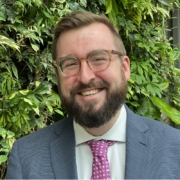
My Kippah
Yesterday, the doorbell rang. To my delight, it was one of my friends recently returned from Israel, and he had come over with a gift for me. In his hand was a small brown paper bag, “Delivery straight from Jerusalem!” What was inside the bag? Beautiful new hand-knit kippot.
For nearly a decade now, I’ve worn a very specific kind of kippah, a kippah srugah. Mine are white with a single band of colour, hand-knit (technically crocheted). In North America, it is just a kippah. In Israel, a kippah is a political and religious statement. And a kippah srugah is a sign of allegiance with the daati leumi, the national religious Zionist.
I wear it for a different reason, however. I’ll tell you why in a moment.
When you wear a kippah every day, there’s wear and tear. That’s why every time I travel to Jerusalem, I always go to the same shop, Yad L’kashish, to refresh my supply. When brides and grooms are taking honeymoons to Israel, and students or friends are telling me that they are visiting Jerusalem, I’ll often make a small request that they bring me back one of these kippot. Especially if they are travelling at the end of summer! That way, I can have a new one for the chagim.
But the war with Iran forced all those lovely couples and travellers to change their vacation plans. I had made peace with the fact that this year, for the first time in many years, this ritual would be taking a year off. Ordering it online didn’t feel right. I accepted that I would not have a fresh kippah for the holidays. But, lo and behold, a delivery found its way directly to my front door anyway.
The arrival of these new kippot was a welcome shock to the system. Since the 12-Day War with Iran and the cancellation of so many people’s summer plans and programs, I had internalized a feeling that there was simply no way to get to and from Israel. But seeing my friend at the front door, freshly returned from an amazing vacation, with a bag of kippot in hand, was a moment of normalcy in a deeply unsettling time. It reminded me that the ‘travel line’ to and from Israel has been restored. People can, and should, go to Israel. To study, to vacation, to visit friends and family. To simply be. Especially if you changed or cancelled your plans this last year.
So why do I wear a kippah srugah? My teacher, Rav Meir, once asked his students to explain how they had chosen their respective kippot. “I like this colour!” said one. “I like this style,” said a second. “To keep my head from burning!” said another! “Good enough answers,” replied the rabbi, “now let me tell you why I wear this kippah.” He said, pointing to his white and brown knit kippah srugah.
“To me,” he said, “the kippah srugah represents a Zionism that believes in the redemption of the world as a process. Not as a miracle that happens all at once. It must be knit loop by loop. It must be done by hand. It takes work.”
His reason, and his style, became my own. Each morning, putting on my kippah reaffirms my belief in that vision of Zionism. A Zionism that takes work. A Zionism that is building a redeemed world. Not in one grand hour. But loop by loop, moment by moment, day by day.
One of the most vital – yet sometimes unfortunately overlooked – ways for Jewish Canadians and our allies to become engaged in advocacy is with our municipal governments. While it has always been important, having a strong relationship with local leadership across our city has increasingly become a critical point of influence. CJPAC, identifying this trend, is launching a 50-person cohort to gain pivotal skills and engage in relationship-building before the municipal elections in just over a year from today.
You can learn more and apply to be part of this initial ACT Cohort here.
CJPAC writes… “This fall, participants will join a select cohort of like-minded community members for four weeks of interactive online training, followed by an in-person gathering and hands-on campaign experience. Guided by experienced campaign professionals, you’ll gain hands-on campaign experience and connect with a powerful network of changemakers who care about making a difference close to home.”
The application deadline is August 28th. If you are looking for a way to make a tangible difference in our upcoming elections on behalf of the Jewish community, and at the same time represent Holy Blossom, please apply!
Learn more about Advocacy@HBT here.

1950 Bathurst Street, Toronto, ON, M5P 3K9
(416) 789-3291
[email protected]
Emergency Funeral Contact
Cell: 416-565-7561

Founded in 1856, Holy Blossom Temple is Toronto’s first synagogue with a rich history of tradition and modernity in our religious and spiritual expression.