




We The North: Holy Blossom’s 10-Day Tour of Northern Israel
By Jerry McIntosh
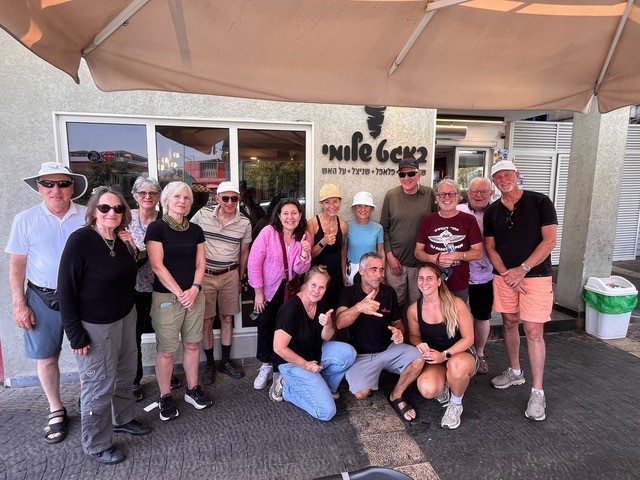
We joined more than 100 Israelis for the anniversary of the horrific events of October 7th in a moving ceremony in the community centre of Kfar Giladi on the northern border of Israel. The village, site of an initial battle in 1920 for the survival of the Jewish people in the land of Israel, is where Joseph Trumpeldor, the early Zionist hero, died. Later that evening, our group gathered for dinner and reflection in a unique restaurant built over a bubbling stream nearby. Our waiter was visibly moved by the arrival of a dozen tourists from Canada; we were among the first foreign diners to return after a three-year absence triggered by a barrage of Hezbollah rockets from nearby Lebanon. After telling us he had lost friends in the slaughter of the Nova Festival, ironically, he expressed concern for Jews in Toronto facing rising antisemitism. This concern and solidarity amongst Jews remains my most outstanding and consistent memory of our recent Holy Blossom “We The North” ten-day mission to Israel. As we dined on a delicious fish dinner, the waters of the Dan River literally flowed beneath our feet toward their eventual destination, the Jordan River.
The flow of history and the course of Jewish survival were reinforced time after time as our group continued our journey. From the Arbel Cliffs to the Golan Heights, through the rich fields of the Galilee and Crusader forts of Acco, our knowledgeable tour guide Uri Feinberg provided the historical context, while his childhood friend, our Rabbi, Yael Splansky, stood alongside as his tag-team partner, providing moving scriptural and spiritual commentary.
All along the way, we were introduced to “typical” Israelis who offered unexpected stories of everyday life amidst extraordinary circumstances. There was the doctor, Avichai, who joined us for dinner, clad in his IDF uniform with the ubiquitous Katsar carbine slung over his shoulder. He explained that he might be interrupted before dessert because he was dealing with an automobile accident; sure enough, his encrypted mobile phone rang, and he had to take a call before returning to continue his briefing with us on what it’s like for a reservist physician being called away from his hospital to serve on the northern border. Quiet, calm and unflappable, Avichai seemed more concerned about the extra burden his absence from his regular job in the hospital had on his colleagues than his IDF duty. It was only the next day when we read the news that we learned about one dead and three injured soldiers whose Humvee had flipped over in Lebanon. Tragically, this was most likely the subject of his urgent phone call. Over and over again it was the same story: Israelis quietly doing their duty for their fellow Israelis.
Erin and Nir on Kibbutz Misgav Am are another example: A pair of environmental activists, they had recently completed their reserve duty and were helping build a nature centre for a community recently devastated by a friendly-fire incident that took the life of Kibbutz elder Poshko Moskovitz. The consequences of war with neighbouring Lebanon did not extinguish Erin and Nir’s drive or good humour as they led our group through a half-day volunteer effort to clear a patch of land and build a couple of picnic benches for the community. We were all moved by the optimism and resilience of these two enthusiastic members of Malavlev, an organization that believes a connection to nature, the land and community is essential. We were happy to do our small part in supporting them.
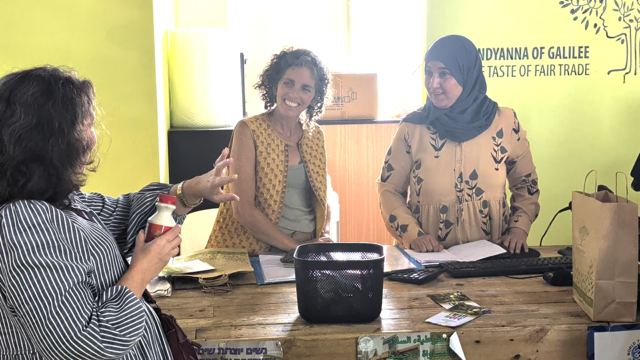
Further south, near Nazareth, we met Devorah and her Arab business partner Maysar, who work in a struggling female-led non-profit that promotes “business for peace” and Fair Trade by selling Arab olive oil and olive products. Sindyanna of Galilee is reclaiming derelict lands and converting them to organic olive groves. But their efforts in support of shared society are being undermined by the global BDS movement, which is causing olive oil orders to dry up. Even Israeli tourists are no longer stopping by the centre, but these women continue their joint efforts on behalf of Arab society as a whole, building bridges with Jews and Arabs. We sensed that even our small group’s visit was meaningful to this courageous team that has not given up on rebuilding the missing link between Arab farmers and the Israeli market.
Another remarkable experience was the recognition of the intimate and sometimes unexpected connections between the people we met and the Holy Blossom community. We met several Shinshinim who had spent a year in Toronto as guests of our congregation’s families. Rosie, the first-ever Shinshinim, now a mother of three, is a junior high school teacher who lives north of Tel Aviv. She says her most difficult task is to instill values of tolerance of Arabs in her students amidst the war. But alongside that challenge, she is proud that Arab fellow teachers find a sense of safety once they arrive at the school. At no point did our group feel in danger. In fact, it was the exact opposite. When we gathered at Or Hadash for Kabbalat Shabbat service in Haifa, there were no signs of security. Unlike Toronto, there were no police guarding the door, no bag checks; Kiddush was celebrated on the terrace under the sky, openly and joyously.
Poetry and song were constant companions on the tour. On a nature trail near Haifa, the words of poet Iris Eliah Cohen were particularly poignant. Struggling to save the complex emotions around October 7th to a computer file, she writes: I call the file “Grief”, Delete. Call it “October”, Change to “Shivah”. As Rabbi Splansky explains, it’s a play on words: in Hebrew, Shivah is 7, and in Israel the events of that devastating day are known as “Shivah b’October,” not the signature “October 7th” we are accustomed to hearing in Canada. And finally Cohen writes: Instruct the computer to remember. It answers me “Save Hope”. In Hebrew, hope is Tikvah, and Hatikvah of course is the national anthem of the State of Israel. That refrain of hope accompanied us every step of the way. While the shadow of October 7th hung over our tour, the message that resonated most profoundly was that October 8th is also a date to remember. Because October 8th is the day that Israelis began to rebuild.