
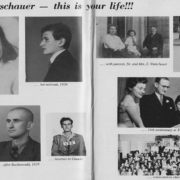
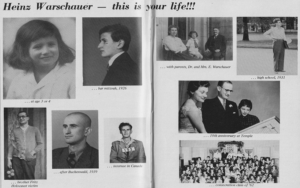
From the Archives: Heinz Warschauer and a Passion for Education
By Ruth Ellen Greenwood
With the focus on education for our 170th anniversary year and the announcement of the Cotler School, the Archives Committee is using this space to highlight noteworthy education moments in our congregation’s history.
Our synagogue has always valued education. In the nineteenth century, Edmund Scheuer took charge of the synagogue’s school and organized a Confirmation class for girls, aged 13, which culminated in 1899. He then organized and financed the Zionist Free School for Girls run by 16 volunteer teachers from Holy Blossom. When Heinz Warschauer came to Holy Blossom, the synagogue’s role in education was well established. Heinz – he was always known as Heinz – raised the standard of education at Holy Blossom even higher.
Born in Berlin, Heinz studied under Rabbi Leo Baeck. In 1938, following Kristallnacht, he was interned in Buchenwald. In 1939, he managed to get to England and from there to Canada in 1940. Ironically, he was interned here as a German enemy alien.
Upon his release, Heinz studied at the University of Toronto and received a Master’s in Modern History as well as a Bachelor of Social Work. Education was his life’s work as evidenced in his innovations to the education programs at Holy Blossom. Heinz always saw the individual, and he believed in group work as the best method for achieving good results.
Starting as a part-time teacher at Holy Blossom, he became full-time Director of Education in 1947 until his retirement in 1976. He was the first Canadian to be President of the National Association of Temple Educators. He was also a member of the Commission on Jewish Education of the Reform Movement, a faculty member of National Federation of Temple Youth (NFTY), and the author of a comprehensive history of Holy Blossom Temple.
The Student Teacher Training program Heinz established at Holy Blossom was well known in the Reform Movement. After Confirmation and completing grade 10 at Holy Blossom Religious School, I and many of my friends enrolled in that program. During this three-year program, we attended a weekly seminar where Heinz and other teachers from the school taught us how to prepare lesson plans, how to motivate students, how to incorporate the AV materials available, and the importance of group work. Each year, we were given a different Religious School teacher as a mentor. We attended the class every weekend morning to observe and participate in teaching parts of lessons, work with students on projects and share in class supervision.
During the six years I taught at Holy Blossom Religious School, as a student teacher and then as a teacher, I finished high school, completed my university courses and enrolled in the Faculty of Education. I quickly realized that Heinz had already taught us the skills covered in that program. I, like so many others, enjoyed a long and fulfilling career as a teacher based on the principles he instilled in all of us.
Heinz had no children and no family; the students of Holy Blossom Religious School were his children and the congregants were his family. Rabbi Plaut described him as “irascible, inspirational and a master teacher”. He also added, “thousands considered him their spiritual mentor.” Heinz was a unique and unforgettable individual who had a profound and lasting impact on all of us who studied and worked with him.
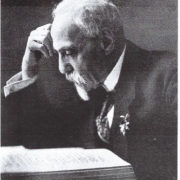



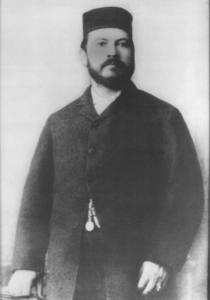 In the early years of Holy Blossom’s existence, we didn’t have a rabbi. Founded in 1856, we didn’t engage a rabbi until 1890. We did, however, need someone who could read from the Torah, slaughter chickens, teach children, and circumcise baby boys. Needless to say, finding one person who could fill the duties of ba’al koreh, shoichet, melamud, and mohel was not easy. Indeed, several candidates were tried and found wanting in at least one of these tasks and dismissed.
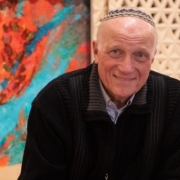
 This past September, we were approached by Mr. Robinson’s great-great-grandson, David Robinson, who asked to visit Nathan’s burial site, and on Monday, September 29, we accompanied David and three of his cousins to Pape Avenue. David told us that Nathan’s son moved to Winnipeg, and David lives there still. David has taken a great interest in his ancestry, and we were happy to provide him with information on Nathan’s part in Holy Blossom’s history and to lead him to his ancestor’s final resting place.

 Each of the three finished tapestries depicts four figures rejoicing, with the Hebrew text from a fragment of Psalm 100 overlaid. In a December 1989 letter to Rabbi Dow Marmur, Gentles cites the psalm as the primary inspiration for the pulpit covers. She uses the following translation of verse two and the first line of verse three—“Serve the Lord with gladness! Come into His presence with singing! Acknowledge that the Lord is God.” Though the covers now hang in the northwestern stairwell and not upon any pulpits, they remain beautiful examples of a great Toronto textile artist’s work, and they are well worth seeing if you have the opportunity.
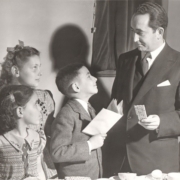
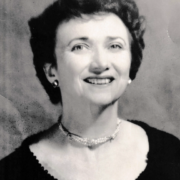
 However, with all of her contributions to the educational side of Holy Blossom’s life (and she was the assistant principal and then principal of our Religious School in the early 1940s), it is as a director of drama, both of students in the Religious School and then with Temple Players, for which she is most remembered. During the 1950s and 1960s, she directed Temple Players in Arthur Miller’s The Crucible, All My Sons, and Death of A Salesman. (A socially conscious woman, Basya was attracted to Miller’s dramas.) Temple Players also mounted a play based on the Thomas Mann novel, Joseph and His Brothers and another, The World of Sholom Aleichem, based on tales of the Yiddish story-teller.