By Happy Iscove
On Shavuot in 1974, Helen Lyon and I read from the Torah and Haftarah as the first “adult” bat mitzvah celebrants at Holy Blossom Temple. This marked a turning point in the congregation’s approach to adult Jewish education and ritual participation, paving the way for greater inclusivity and lifelong learning.
Traditionally, girls become bat mitzvah at age 12 and boys at 13, marking their entrance into the adult Jewish community, complete with its responsibilities.
Many Jews who never celebrated becoming a bar or bat mitzvah as adolescents choose to do so as adults. And some who did celebrate at the traditional ages choose to take part in a second bar or bat mitzvah observance at age 83.
Psalm 90:10 reads: “[As for] the days of our years, in them are seventy years…”
The tradition of celebrating a 2nd Bar Mitzvah at age 83 is based on the idea that 70 years after the first, a person has lived a full biblical lifespan and can mark a new spiritual milestone.
Since a Jew becomes a Bar Mitzvah (literally son of the commandment) at age 13, and remains so throughout his life, the term 2nd Bar Mitzvah seems a misnomer. Nonetheless, it is a beautiful sentiment, and the ritual is becoming more common as people live longer, more active lives. In fact, actor Kirk Douglas z”l, not only celebrated a 2nd Bar Mitzvah at age 83 but a third at 96!
Four men in our own congregation have participated in a 2nd Bar Mitzvah.

Nine years ago, Robert Ruderman approached Rabbi Splansky about observing the custom. To mark his 83rd birthday, he led the Ashrei and chanted sections from his original bar mitzvah Torah and haftarah portions.
 As a youngster, John Freund celebrated his bar mitzvah in Terezin. Although his family and town rabbi were there, it was different from what it would have been under happier circumstances. Grateful for his survival and appreciative for his life in Toronto, when John turned 83 in 2013, he chose to read part of his original Torah portion – thus marking his second bar mitzvah.
This past October, Harvey Naftolin spontaneously celebrated his bar mitzvah for the second time. It must have been beshert. The night before, after Erev Shabbat services, Harvey mentioned to Rabbi Splansky that that week was his bar mitzvah portion – Bereshit. She asked Harvey how old he was and if he still remembered his portion. “83 and yes, I remember.”
Harvey read from the Torah the next morning, accompanied by the full fanfare accorded a bar mitzvah.

Mark Zeidenberg is in a unique situation. He was born 52 years ago on February 29th, a leap year. This year is his 13th birthday on that actual date. He is excited to mark the occasion with a second bar mitzvah – an Aliyah to the Torah.
These men found the 2nd Bar Mitzvah experience to be particularly meaningful and were proud to share it with their families and our Holy Blossom congregation.
If you will be turning 83 and would like to celebrate with a second bar/bat mitzvah, please contact JoAnne Bieman at 416 789-3291, extension 276.
Editor’s Note: The following reflection was originally written in 2020 and, while newly published, contains some references and timelines that reflect that period.
By Sydney Scarlata
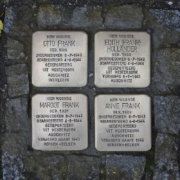
Amsterdam is not a new city for my husband, Jacob, or me. We’ve been enough times to feel comfortable navigating the city’s bike lanes, tram lines, and canal systems. However, on our first night in town, Jacob’s cousin Ethan — who had recently moved to the Dutch capital — called our attention to a small detail in the sidewalk. Having spent the last year studying Judaism at Holy Blossom, I had a new perspective through which to view Amsterdam and these little sidewalk details.
While I learned about the country’s arguably most famous Holocaust victim, Anne Frank, as a kid, I was relatively unfamiliar with Amsterdam’s Jewish history. In 1941, nearly 79,000 Jews resided in the city’s iconic row houses. As a result of Nazi occupation and mass deportations throughout World War II, nearly three-quarters of Dutch Jews were murdered. Their names are now inscribed in the city’s Holocaust memorial in the Weesperstraat neighbourhood. But the city — and Europe writ large — went a step further in creating a collective memory about the Holocaust. In 1992, German artist Gunter Demnig installed small, 10×10 cm, brass plaques on the sidewalk outside the known residences of the War’s victims. Demnig’s inspiration for this project was to further an idea in the Talmud that “a person is only forgotten when their name is forgotten.”
The plaques are simple; each one lists the person’s name, year of birth, when they were deported, arrested, or went into hiding, and whether they were murdered, liberated, or survived. Upon further research, I discovered that the craftsman who makes each plaque engraves every letter with a hammer and a hand-held metal stamp. “To show respect for the victims, it must be done by hand,” he told the Guardian in 2019. These “stumbling stones” can be found throughout Europe, but this was our first conscious encounter with them.
Once we knew what they were, we saw them everywhere. I have toured Holocaust museums before and stood in front of the remembrance walls, allowing the names to wash over me like a wave. But there was something so profound and deeply humanizing about associating a plaque with a person, and a person with a place. It was as if the plaque was telling me, “This person was once here, and there’s a reason they are not here anymore.”
These tiny squares made me think deeply about property, remembrance, and justice. We know who lived in these homes. It is literally etched into the ground in front of their doors. Who lives in these houses now? Do they understand and appreciate the history of their home? Does it matter if they don’t? Should these homes be returned to the survivors? To Jews? As North Americans, we must contend with our own government’s decision to forcibly remove (and slaughter) Native peoples from their land. In reading Indigenous writers and activists, I am struck by how challenging it must be for tribal leaders to negotiate and reconcile with the governments of Canada and the United States when our concepts of land ownership and our relationship to the land couldn’t be more different. Merely recognizing that we live on stolen land hardly feels like enough, just as reading the stones in Amsterdam felt insufficient. Though perhaps no one gesture will ever be enough to make up for such a catastrophic loss of human life.
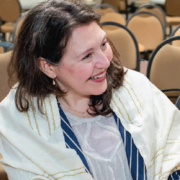
Eric took to this bimah to give his Presidential Installation Address one Shabbat Morning in November 2024. He was actually radiant with pride that day, when he wore the beautiful tallit Beth had woven just for him. Included in his address to our congregation, Eric taught from Pirkei Avot 2.2. Because this is the season of the Omer, when we turn to study Pirkei Avot – a collection of Rabbinic wisdom, compiled some 2,000 years ago — and because this passage was clearly important to Eric, I’d like to lift it up again now, as my final tribute for him.
רַבָּן גַּמְלִיאֵל בְּנוֹ שֶׁל רַבִּי יְהוּדָה הַנָּשִׂיא אוֹמֵר.
Rabban Gamaliel the son of Rabbi Judah HaNasi used to say:
…וְכָל הָעֲמֵלִים עִם הַצִּבּוּר, יִהְיוּ עֲמֵלִים עִמָּהֶם לְשֵׁם שָׁמַיִם,
…All who work with the community, should work for the community for the sake of Heaven,
Eric came by this insight naturally. No one taught him this. It’s how he was built. Eric Roher, the masterful Connector-Promoter-Networker-Community leader, never did these things for self-aggrandizement. In fact, most of what he did, he did quietly, privately, to help advance someone else’s success. Eric understood community building IS work, but it is sacred work.
Holy Blossom Temple was blessed by Eric’s leadership. Today, a grateful congregation gathers to express our admiration for his many contributions. Eric’s work for our community was indeed for the sake of Heaven. It is what we often call a “sacred partnership.” Rachel Malach, Holy Blossom’s Executive Director, and I were lucky enough to meet with Eric every Wednesday afternoon to work in lockstep as we attended to the needs of the congregation. Sometimes very specific questions would be the focus of our attention; sometimes we’d Zoom out and look at the big picture, we’d map out Holy Blossom’s big future, our next 170 years! Eric brought clarity and kindness, encouragement and good direction to that table each week. And he never asked for anything in return, because his commitment to our congregation was “l’shem Shamayim,” “for the sake of Heaven.”
שֶׁזְּכוּת אֲבוֹתָם מְסַיַּעְתָּן –
Rabban Gamliel continues: “The merit of their ancestors sustains the community.”
Eric Roher was a ben bayit [“child of the Temple”] through and through. Five generations of Rohers have made Holy Blossom Temple their spiritual home. Eric’s father, Doug, alav haShalom, was confirmed when Holy Blossom was still downtown on Bond Street. And Eric beautifully eulogized his father from this bimah just three months ago. One of our sanctuary’s stained glass windows was dedicated in 1958 to the memory of Eric’s cousins, Lionel and Martin Roher, who both died young and in service to our country. With pride, Eric recounted their stories in his Presidential article this past Chanukah.
Eric’s parents’ wedding was here in this sanctuary with Rabbi Feinberg. And today, we send our deepest condolences to Eric’s beautiful mother, Laila, who is still among the living, but perhaps it is a blessing that she is unable to comprehend the loss of her son. Young Eric first took his place on this bimah as a Bar Mitzvah with Rabbi Plaut. Eric returned to this bimah for Confirmation, and even from his bed in the ICU, he was singing the folk songs that were part of that life-shaping, teen ceremony. But Eric’s favourite day on this bimah was his wedding day — when he stood before the ark with Beth at his side. Rabbi Prosnit blessed them under the chuppah 43 years ago. Eric returned to this bimah when his daughters read from the Torah as B’not Mitzvah. Through tears, Eric returned to this bimah for the babynamings of his great-granddaughters, Eva and Ruby. His greatest joy was bringing them to Holy Blossom, because he was bringing together two great loves – his family and Holy Blossom Temple.
It is absolute heartbreak and perfect symmetry that today we will escort Eric’s casket down this same aisle, which he walked hundreds, if not thousands, of times. Eric’s Holy Blossom story and the Roher family story are evidence to the truth of Rabban Gamliel’s teaching: “The merit of their ancestors sustains the community.”
וְצִדְקָתָם עוֹמֶדֶת לָעַד.
and their righteousness will forever stand;
Eric’s impact on our congregation is impossible to measure, but easy to feel. During his Presidency, Holy Blossom Temple has been blessed with a time of rapid growth. We are growing larger and younger. One third of the congregation is new in the last five years. And Eric was delighted by our significant baby boom!
One project that Eric was uniquely positioned to take up before his ascent to the Presidency was the development of the Temple’s Ethics Code. We hope we never have to use it, but it is an example of how Eric strengthened the congregation, protected the congregation, and set us up for future successes. As President, Eric could be serious and focused, and he was also our greatest cheerleader. He led his Board with good humour and constant encouragement. He cheered on our Clergy Team — quick to compliment and praise our work. I know I speak on behalf of my colleagues – Cantor Rosen and Cantorial Soloist Lindi Rivers, Rabbi Kaye, Rabbi Baruchel, and Rabbi McCarroll – when I echo the words of Pirkei Avot: וְצִדְקָתָם עוֹמֶדֶת לָעַד. “His righteousness here will endure.”
Holy Blossom leadership pledges to carry forward his legacy here at Holy Blossom Temple. Eric made sure of that by mentoring a deep bench, including Eric Klein, Richard Toker, a strong Executive, and a strong Board. And many esteemed Past Presidents, who stood on guard for him today, will continue to support our congregation as we navigate our way without him.
וְאַתֶּם, מַעֲלֶה אֲנִי עֲלֵיכֶם שָׂכָר הַרְבֵּה:
And as for you, [God says, in such case], I credit you with a great reward,
What was Eric’s God-given reward? An unusually good and an unusually full life. That was his reward. Eric also understood instinctively the ancient Rabbinic teaching that “The reward for the mitzvah is the mitzvah.” The satisfaction that comes from taking up the mitzvah and seeing it through is the reward in and of itself. Eric found pleasure in the effort, pleasure in the work, pleasure in the connection. He often told Beth, “I tried.” For Eric, there was a sense of accomplishment in the trying, in the striving, in the searching out and in finding the way forward.
And finally…. Rabban Gamliel, who was himself accomplished and driven, but also aware of his own mortality, taught:
כְּאִלּוּ עֲשִׂיתֶם
It will be as if you [yourself] had [actually] accomplished [it all].
Eric walked fast. His energy was boundless. His enthusiasm and curiosity were almost childlike – an insatiable sense of awe for the possible. He brought this optimism to everything, including his own health. When his doctors eventually told him, “We’re sorry, there is no hope for a cure.” Eric said: “OK. So what’s the plan?”
There was so much more Eric wanted to experience. So much more he wanted to share with all of us. And most of all with his beautiful family. At one point, his goal was to come home from the hospital in time to light Chanukah candles with his family. And he did. Then he wanted to have chemo, so the very next day, he could lead our Temple Board Retreat. And he did. Then he wanted to care for his own father in his final days. And he did. Then he wanted to join his family from the hospital through Zoom for their Seder. And he did. Then all he wanted was to stand by Rebecca on her wedding day. And he did. Eric told me more than once, “I just want to finish my Presidency.” According to Rabbi Gamliel, it is “K’ilu” – as if he has.
There was so much more Eric wanted to live to see and do. He packed so much into each day of his life, we can say it is “K’ilu” – as if he had been blessed with length of years. He truly was blessed with an extraordinarily full life, if not a very long life.
Once, when we thought it was the end, I went running to the ICU to offer the Viddui, the end-of-life prayer. But on my way, I learned that Eric had already been transferred back to his room at PMH. I couldn’t believe my eyes when I walked into the room. There was Eric, sitting up, holding court, telling funny stories, and asking about a special project underway for Excellence in Education at Holy Blossom. So instead of the Viddui, the only thing we could do was sing the Shehechiyanu – the simple prayer for profound gratitude for God who gives us life, who sustains us, and who enables us to reach another day. Every day was a Shehechiyanu for Eric, because he made it so.
No doubt, Eric’s life was extended by his strong will to live and also by the loving care of family and friends who rallied to his side. Beth, Jessica, Rebecca, and Sophie were with him – day and night, day and night, day and night. Together with Lewis and Grayson, they provided him with every comfort. Together with Kevin, Joanne, and Susie, they treated him like a Biblical patriarch. Together with lifelong friends, we were able to tell him and show him what he meant to us.
Now his body is wrapped in a tallit. On the corners of the tallit are the tzitziyot, which represent the mitzvot Eric fulfilled and those he strived to fulfill. And now, according to Jewish custom, those tzitziyot are cut to say: “Your work is done. Now you can rest, Arieh ben David v’Lailah. Be at peace.”
Zecher tzadik livrachah. The memory of the righteous are for blessing.
Because Eric was so devoted to Holy Blossom Temple, the family welcomes donations to be made in Eric’s honour at Holy Blossom to either Excellence in Education or Outreach & Next Gen, as well as to Princess Margaret Hospital. You can donate online here or contact Marni Turner at [email protected] or call 416-789-3291 x 227 or Joe Freedberg at [email protected] or call 416-789-3291 x 260.
We gathered around the Roher family to comfort them and to honour Eric’s life of service on Sunday, April 26. You can watch the meaningful service here.
Stephanie Smyth MPP for Toronto-St. Paul’s delivered her member’s statement honouring the life of Eric Roher z”l. Click here to watch the touching tribute to her dear friend.
Click here to read the moving tribute by Dave Gordon in the National Post
We would like to draw your attention to two important events that are coming up at the beginning of summer!
On Monday, June 29th, Holy Blossom Temple will be hosting an intimate conversation with respected Canadian political commentator, Warren Kinsella. Mr. Kinsella has written a new book called “The Hidden Hand: The Information War and the Rise of Antisemitic Propaganda.” He will be with us to discuss his new book, copies of which will be available for purchase and signing, and to share what he has learned about the forces which are motivating the organized campaign against Jewish life in Canada.
“Canada has become ground zero for this international effort, a result of shifting demographics, porous online and physical borders when it comes to foreign interference, lack of political will, and failure to enforce laws that could help prevent the spread of this type of hate. The numbers themselves are astounding, reflecting a growing tide of antisemitism, anti-Zionism, and general intolerance with a brazenness that has not been witnessed before. A country known for its historic support for the Jewish homeland and for Jews in general has become, since October 7th, a place where Jews live in fear, with skyrocketing incidents of vandalism, violence, threats, and intimidation.”
You can learn more by clicking here. Registration will be live soon.
Additionally, it is once again time for the UJA Walk with Israel. We’re proud to walk alongside Toronto’s Jewish community and allies at UJA’s 2026 Walk with Israel on June 7th. More information will be coming soon, as the security conditions become more transparent.
Pre-Registration for the walk is always important, and you can sign up directly here.
Learn more about Advocacy here.
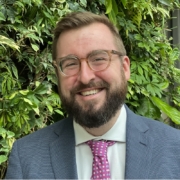
Years ago, when I arrived in Israel, I made friends with a young man from the East Coast who was also at the beginning of his spiritual journey. Both of our paths would ultimately take us into the rabbinate, but that is where the similarities ended. He found his people among the disciples of Rebbe Nachman, the Breslovers or Nachmanites, smiling Jews you often see in Jerusalem with a special knit kippah, leaping from their cars to dance at red lights, and playing loud upbeat club tunes remixed with Jewish themes.
The best known and most important teaching of Rebbe Nachman, and perhaps the hardest one to follow, is this. It is a great mitzvah to ALWAYS be happy.
“Serve God with Joy!” says the Psalmist, and the great rabbi took this quite literally, teaching that depression, sadness, and despair are the tools of the evil inclination – distancing your soul from God. Instead, choose happiness and joy, as this will bring you closer to the Holy One.
I always found this teaching simultaneously inspiring and impossible. Life is full of emotions other than joy. Sadness and loss are normal and human. Grief, too, has its place in the Jewish world, sanctified and ritualized by our rituals and prayers. Always be happy? Always?
One day I asked my friend, now fully immersed in this world, how did he do it!? How did he always, authentically, find happiness when the world was dark or when pain filled his life? He smiled (because of course he smiled), and what he said next has stayed with me ever since.
“When I am broken-hearted… I do a mitzvah.”
There’s a lot of tsurrus in the world right now, many reasons to be upset or angry, scared or sad. From personal grief to national worry, international concern for our Jewish people to immediate loss in our Holy Blossom community. Telling you ‘Don’t be sad, or scared, don’t grieve or be concerned’ is not my Torah. But that little twist, that ray of light and hope that my friend taught me years ago, it has stuck and become my personal practice.
When you are broken-hearted, do a mitzvah. Do the mitzvah that you are suited for. Prayer and action; learn, serve, teach! And if you don’t yet know what mitzvah suits you there is one I particularly want to recommend.
Please join us in bringing donations of shelf stable food to the Janis Rotman Tzedakah Centre, right inside the doors of the shul, and leave them there for our dedicated volunteers to fill the tiny pantries. In this way we care for our anonymous neighbours, in fulfillment of the teachings of Maimonides. Each small donation makes a big difference in the life of a fellow traveller up and down Bathurst St.
For as Maimonides teaches…
“No harm has ever come from the giving of tzedakah, nor has anything bad come from it, as it is written ‘The work of tzedakah, is shalom.’” Mishneh Torah, Gifts to the Poor, 10:2.
Moment by moment, step by step, mitzvah by mitzvah, we find our Shalom.
Shalom for our world. Shalom within.
This week, happy or sad, whether the world is breaking your heart or not, listen to my friend. Go and do a Mitzvah.

by Carly Steinman, Chair of the Search Committee
Welcome, Dr. Cindy Kozierok
Holy Blossom Temple is thrilled to welcome Dr. Cindy Kozierok as our inaugural Director of Lifelong Learning, starting July 1, 2026. The Director of Lifelong Learning will be the senior educator of our congregation, driving the overall vision, strategy and innovation for learning at all life’s stages.
“Never once in my life did I ask God for success or wisdom or power or fame. I asked for wonder, and God gave it to me.” – Rabbi Abraham Joshua Heschel.
These words guide Dr. Kozierok’s approach to Jewish learning and were emphasized in her application and interviews. She believes, at its core, education should nurture awe and joy, inviting each learner to grow and shape meaning for themselves.
Dr. Kozierok brings 25 years of teaching experience at the Toronto District School Board and seven years as the Director of Education at Beth Radom Congregation. She grew up in Toronto, and as a lifelong learner, recently earned an Executive Doctorate of Education from the Jewish Theological Seminary in New York City. Dr. Kozierok is also known in Ontario and beyond as the Holocaust Education Chair for Liberation75.
So what is this new role, and why now? Holy Blossom Temple began dreaming of this position long ago. With funding in place, the formal search began in 2025, led by a new Search Committee, composed of congregants Daniel Abramson, Karen Kollins, Mark Madras, Kate Rosen, and Barbara Sandler, together with ex officio members, VP of Education, Diana Solomon and our Senior Rabbi, Yael Splansky. This group brought care, wisdom, and dedication to the process. Over months, they reviewed applications, asked thoughtful and probing questions, and engaged in rich, sometimes challenging conversations about what lifelong learning could look like in our community. As Search Committee Chair, I extend a profound thank you to each member.
Lifelong learning is about elevating formal and informal learning for all our congregants at all ages. This Director position involves supervising and working with our two experienced Principals of the Youth Education Centre and the Early Childhood Education Centre. Together, they will continue to build deep and rich curricula and programming for children and teens.
Dr. Kozierok will envision innovative pathways and new frameworks for adult education, and work in sacred partnership with clergy, lay leadership and professional staff to elevate Holy Blossom Temple into a thriving hub of multigenerational learning—where curiosity, tradition, and community come together to inspire minds and nurture souls.
And as Holy Blossom turns 170, we are celebrating excellence in education on May 11th, when Dr. Kozierok will make her first appearance on the Holy Blossom ‘stage’ for North of Broadway. Please join us in welcoming her with a rousing chorus!


Welcome to Rosh Chodesh Sivan on Sunday, May 17, at 9:00 am – All are welcome!
The Women of Valour Series is generously sponsored by Robert Lantos in memory of his mother Agnes Lantos z”l
Zodiac sign – Gemini (The Twins)
Sivan, the third month of the Hebrew calendar, reflects the spiritual power of the number three—seen in Moses, the third child, and the three-day preparation to receive the Torah.
This month, we celebrate Shavuot, commemorating the giving of the Torah at Mount Sinai over 3,300 years ago. Each year, we renew this sacred bond, likened by our sages to a wedding between G-d and the Jewish people.
The essence of Sivan is Tiferet—harmony and truth—a balance of justice and compassion, embodied by Moses and Aaron, and reflected in Gemini, the twins. The story of Ruth, read on Shavuot, reminds us of the courage to pursue a life of deeper purpose and truth.
By Lesley Simpson
I interviewed Dalia in late March 2026, before my bat mitzvah in May. At that time, Dalia said, “I still can’t believe this honour, eshet chayil for rosh chodesh. I’m the luckiest person on earth to be able to do what I love the most, teaching and helping out.”
I first met Dalia when I joined the HBT Monday night Aleph Bet class in the fall of 2025.
I joined because I have an Olympian level of Jewish curiosity. I was not planning to have a bat mitzvah; however, when I heard about the opportunity to learn cantillation, my interest was piqued, and I was terrified. “We leave nobody behind,” Dalia told us. She mentioned that once she did have a student faint, but that her system was foolproof. We had to trust the process.
Dalia created a pedagogical system for cantillation. With each parsha, she underlined different phrases in different colours. Red, blue or green pencil indicated which trope to use. We were given a recording of the tropes. As I progressed, I earned the right to add another colour to my parsha, Leviticus 25 8-13. I kept the parsha in my purse. For an English speaker, this skill of cantillation is not easy because there is the visual pattern recognition required to recognize and pronounce the Hebrew, as well as trope melodies. To make it more daunting, the trope itself is not in the Torah parchment.
What is surprising about Dalia is that Hebrew is not her first language. She was born in Bacau, Romania, in 1948 and immigrated to Israel in 1959. Romanian was her first language. She and her family moved to Neharia, and she learned Hebrew in Kibbutz Eyn Dor. The move was difficult for her family. Her mother, who spoke many languages, worked at a restaurant to keep the family afloat financially. Dalia was eleven years old when she landed in Israel and had no Jewish background. Being Jewish in Romania had been a liability with systemic discrimination in many quarters of society, from school to government. Dalia remembers the hatred towards Jews she experienced within the school system, where Jews were not given the same opportunities as others. Jews were singled out and humiliated. Subsequently, in her family, Judaism skipped a generation.
Her own parents did not observe Jewish rituals or traditions (She did not attend her first Passover Seder until she met her husband Jack when she was 19 years old, and his family’s Seder unfolded in Ladino!) But before she met Jack and landed in Israel, a new world opened for Dalia, and she learned Jewish texts as well as the Hebrew language.
“I attended school, then high school; I worked hard to catch up with all the Bible, Talmud, and Israeli literature I had missed in my early years. I bet this is where my understanding, compassion and patience towards students—kids and adults—comes from, knowing how difficult, strange, new things are and competing with others. Then I proceeded to study in teachers’ college in Beit Berl, Kfar Saba.
Dalia lived in Israel for eight years, and on April Fool’s Day, she met Jack, her future husband. He had served in the Israeli Air Force and, upon his discharge, looked for work in Israel. There was no work. He had a sister who lived in Canada who sponsored him. He arrived on a Friday in 1967 after the Six-Day War, and on Monday, he was hired at De Havilland Aircraft Company. This August, the couple will celebrate their 59th wedding anniversary.
“Teaching was in my DNA. I was always surrounded by children and tutored many. It was my real passion.” Dalia worked at Beth Am, Beth Tikvah and Beth David synagogues, and then applied to Holy Blossom Temple, which has been her “second home” since 1971.
“What makes teaching adults different is that they have chosen to learn. They are not being forced. Each person learns differently…. Each person I come into contact with is a gem.”
There is a quote from our Proverbs (22:6), which states:
חֲנֹ֣ךְ לַ֭נַּעַר עַל־פִּ֣י דַרְכּ֑וֹ גַּ֥ם כִּי־יַ֝זְקִ֗ין לֹא־יָס֥וּר מִמֶּֽנָּה׃
Educate children in the way they each ought to go;
They will not swerve from it even in old age.
Excellence in Education, and particularly our value of Lifelong Learning, was one of the major reasons that I was so eager to join the team at Holy Blossom back in 2022.
I knew that we had a reputation for deep learning, for engaged students, for high-level scholarship, and prestigious guest teachers, and I couldn’t wait to be a part of it all.
I have been proven right since, with one of the most rewarding pieces of my role being when I get to be part of those educational moments: whether it’s on the occasions I get to teach Torah study or a class series, or when I’m with our students on Sunday morning, or when a scholar-in-residence comes to town.
With our rich history in, and valuing of, Jewish education, it feels so special and appropriate that on the evening of May 11, as we mark 170 years of Holy Blossom Temple, education will be our key focus.
As we enjoy our magnificent “North of Broadway” event, we will celebrate our community, leadership, and resilience, and dedicate this night to Excellence in Education with a red carpet and spectacular musical performances!
Join us also for some very exciting announcements about the future of Education at Holy Blossom Temple, as we both honour our history and invest in the next generation of our vibrant congregation.
Beginning with a VIP cocktail reception at 6:30 pm, the doors for general admission will open at 7:30 pm, and all are welcome to join for a delicious dessert following the concert.
For more information and to buy your tickets, click HERE.
Tell your family, tell your friends, bring them along, spread the word, and we can’t wait to see you there!
At all ages and stages, and in every generation, may our reputation for educational excellence precede us.
To the next 170 years!

1950 Bathurst Street, Toronto, ON, M5P 3K9
(416) 789-3291
[email protected]
Emergency Funeral Contact
Cell: 416-565-7561

Founded in 1856, Holy Blossom Temple is Toronto’s first synagogue with a rich history of tradition and modernity in our religious and spiritual expression.