When we think about the mark we want to leave on the world, few actions carry as much weight as planning a legacy gift. A legacy gift, or charitable bequest, is a powerful way to extend your values and vision far into the future, supporting causes that matter deeply to you. Holy Blossom Temple has been a cornerstone of Jewish life, learning, and community for generations. By including Holy Blossom Temple in your estate planning, you help ensure that future generations will continue to benefit from its vital programs, services, and spiritual guidance. Your gift becomes part of a greater story – one of continuity, community, and Jewish values. Legacy giving also offers significant tax advantages that can benefit both you and your heirs:
By working with your financial advisor and Holy Blossom Temple’s planned giving team, you can create a legacy plan that maximizes both your philanthropic impact and tax benefits. Your legacy gift to Holy Blossom Temple is more than a donation – it’s a partnership in sustaining Jewish values, community, and tradition. Whether through an outright bequest, life insurance policy, or a gift of securities, your gift ensures that the light of Jewish learning and community continues to shine brightly for generations to come.
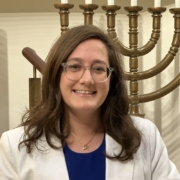
By Eli Sol
This July and August, I had the absolute pleasure of working in the Holy Blossom Archives with the committee of volunteer archivists (Susan Cohen, Sheila Smolkin, Susan Mogil, Howard Roger, Michael Cole, Judy Winberg and Ruth Ellen Greenwood). The idea was first pitched to me in an academic context. For the final paper of my “History of the Jewish People” class this past April at the University of Toronto, I elected to write about the influence of lay leadership on Holy Blossom’s musical journey in the early days. The archivists were kind enough to accommodate my research needs and provided all the materials as well as an invitation to work there over the summer.
I travelled to Israel with Birthright in June and July, and once I returned to Toronto, I was ready to get to work in the archives. The main task was digitally cataloguing the mountain of musical materials left to us following Cantor Maissner’s retirement, which laid the groundwork for the new Cantor Benjamin Z. Maissner and Holy Blossom Temple Music Archive and Library. This new section of our archive library includes both digital and physical copies of posters, event programs, photographs, service plans, commissioned works, tapes, CDs, books, folders, pamphlets, and everything in between. The current plan is to store a selection of the physical materials in a designated cabinet of the Max Enkin Library on the main floor.
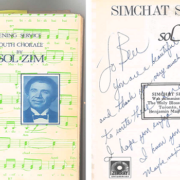
I had the privilege of interacting with an impressive scope of manuscripts. The materials mostly came from Cantor Maissner’s own 41-year career, not only as Holy Blossom’s cantor, but also as the head of the LACHAN community chamber choir, and a powerful, internationally recognized Jewish musical voice. Two of my favourite sources are Beny’s original, used, and annotated vocal score of Leonard Bernstein’s “Kaddish Symphony No. 3” and a Kabbalat Shabbat service of Hassidic tunes arranged for mixed choir by Sol Zim —the inside cover of which bears a lovely note to Beny from Sol Zim himself.
Many of the exciting musical documents in Cantor Maissner’s library predated him, revealing a wealth of inherited Jewish music dating as far back as the 1880s. Some highlights include:
I would be remiss not to mention Jill Kamin and Gillian Rosenberg’s separate but related venture to digitally scan the complete corpus of Cantor Maissner’s musical career which will soon be housed in the National Library of Israel. Their project has been instrumental in filling out the digital side of The Cantor Benjamin Z. Maissner and Holy Blossom Temple Music Archive and Library and is more than deserving of praise.
If you are curious about exploring this new branch of the Holy Blossom archives, or about our exciting investigations into Holy Blossom’s extensive history, I encourage you to get in contact with our archivists. If you are just looking to dip your toes in, several artifacts of Holy Blossom history are displayed year-round throughout the Schwartz Reisman Atrium for exactly that purpose.

By Jack Kugelmass with Arlene Roth
In the Spring of 2024, Holy Blossom Temple was approached by our Temple member Dr. Nate Charach, with a riddle. “What do you call a program that combines psychiatry with climate change?” The answer: “Psychiatree”! www.psychiatree.ca
Dr. Nate Charach, a psychiatrist and the founder of psychiatree.ca, briefed the L’Chaim Program and the Luke Sklar Mental Health Initiative Committee (LSMHI) about a 6-session group program he has created that serves to help build resilience to individual and group trauma. This program was offered to us for members of the Jewish community’s post-October 7 world when many of us are experiencing feelings of fear, helplessness, shock, and anger – both concerning Israel and the antisemitic environment at home. With the guidance of Rabbi McCarroll, the Holy Blossom Temple hosted the group program run by Dr. Nate Charach. Six Temple members signed up for the series.
In our time together, we were introduced to three themes, each of which weighs on our lives as Jews in a post-October 7 era. Dr. Charach noted that he was guided in pursuing this work by the teachings of authors Joanna Macy and Chris Johnstone in their bookActive Hope: How to face the Mess We’re in with Unexpected Resilience and Creative Power.
First, even as we witness and experience the trauma of the October 7 pogrom, we have an opportunity to promote post-traumatic growth for ourselves and our world. We can work toward that goal by honouring our pain and the pain of all affected by trauma.
Second, rather than a personal journey, our pain is connected to the pain of others. Only through a community with a positive vision can we build the strength to act in the service of others in our world. Overcoming pain is facilitated with action or in Jewish terms, acts of loving kindness. It also involves “active hope” – a concept that suggests that hope has meaning only when we act in pursuit of a desired outcome.
Third, a path to “active hope” is for all of us to recognize that the earth and all that lives within it is at risk unless we come together to protect and heal our world with all our individual strengths. Healing comes with joining others in community efforts to preserve all that is good, and to understand and honour that which is causing destruction, and then acting to care for all that lives.
A fellow participant, Arlene Roth, shared her experience of the group as follows:
“Nate gathered universal truths about being human and the role of our precious Earth in our lives to teach us how to hope and bring about positive change for our world. When the course began, I was feeling helpless and full of grief over the war in the Middle East; however, during the time in our group, I grew increasingly less fearful and more confident that I could make a difference and become more connected to others and our planet. I do believe that although there is no quick fix for our troubled world, by taking small steps we can repair and improve it.”
The members who took the program thought that others in the congregation may want the opportunity to take this program (there is a fee). If there is interest among some in our own community who wish to participate in such a group, please contact Dr. Nate Charach at [email protected] or Rabbi McCarrol at [email protected].
Arlene summarizes her takeaways:
The idea of combining the movement addressing climate change with a psychiatric intervention was a new one for me until I noticed our Temple’s Schwartz/Reisman Atrium’s “Living Wall” which contains the 7 species of plant life associated with Eretz Yisrael. While I thought that this was a lovely design feature of the Atrium, I now wondered if the living wall could be connected to the subject of Dr. Charach’s proposal? What if the wall represented more than plant life? What if it pointed us in the direction of creating and sustaining all life on the planet, a tenet central to Jewish life? To do so requires knowledge and action that serves to create, grow and maintain all life with resilience and hope for us and future generations. The series offered by Dr. Charach seeks to help us to develop such skills and consciousness.
The combination of climate awareness and psychiatric knowledge may sound strange to many of us who feel weakened in the face of a broken world; however, writing on behalf of our group, I can state that the discussions and exercises we experienced, helped us emerge from the group series feeling strengthened and more resilient. Furthermore, it was highly informative and meaningful.
Over the last week or so, as we have celebrated and commemorated Simchat Torah, there are two different images that will forever remain in my memory.
One is from Erev Simchat Torah, as we danced and sang and yes, even rejoiced as we ended our cycle of reading our most sacred of texts, and began that cycle once again.
I cannot remember the song, but what I do remember is that a number of us were dancing on the upper bimah, when two little boys – including one who had just received his baby Torah at Consecration earlier in the evening – came to join us, the group of grownups moving around in a circle. They laughed and smiled with us and we made sure they didn’t hit their heads on the railings, and in that moment, I thought to myself, “this is what it is all about, this is the definition of l’dor va’dor, from generation to generation”. This adorable intergenerational moment epitomized the phrase from Kohelet that we have been hearing so much of these last few weeks: et s’fod, v’et r’kod – “there is a time for weeping and a time for dancing.”
The other image is from Tuesday night, as our community gathered with Yaron and Jacqui Vital, parents of Adi Vital-Kaploun, of blessed memory, a dual Canadian-Israeli citizen who was murdered on October 7 whilst protecting her two young sons. Yaron, Jacqui and Adi (z”l) are also the cousins of our Cantorial Soloist, Lindi Rivers.
As many of you will know by now, over the High Holy Days, we dedicated a beautiful new Torah mantle in Adi’s shem tov (good name), sketched and stitched by our talented congregant, Jodi Bager. You can read that story here.
At the conclusion of the evening, Jacqui and Yaron were presented, by Jodi, the Torah mantle designed in their daughter’s honour. There was barely a dry eye in the Mishkan as they held that scroll tightly, surrounded by their Canadian family, and Lindi led us in etz chayim hi, it is a tree of life. In this emotional moment, it was a reminder for us to live life exactly as we learned Adi would have wanted: with purpose, and with joy.
Et s’fod v’et r’kod – there is a time for weeping and a time for dancing, and we as Jews are skilled at holding simultaneous significant, often conflicting, emotions.
What I wanted to share with you, is that lesson in what I have come to understand about what Jewish joy is: crying with one eye and dancing with another, as our history and tradition have taught us to navigate the hardest and the happiest of times, and not to expect perpetual joy but to instead find fulfilment in what grounds us in life – including Torah, and community. These are the things that we hold fast to, for all of its supporters, in every generation are…happy!
The week of October 30, 2024
Antizionist Conference at U of T / Pushing Back the Boycott at the University of Windsor / Special Envoy Deborah Lyons coming to HBT / UN Rapporteur Reprimand.
On November 8th, the University of Toronto will, regrettably, host a conference titled “The Anti-Zionist Idea: History, Theory and Politics.” This conference amplifies “notorious terror apologists and disguises antisemitic ideas as academic discourse.” Legitimizing these voices can only continue to foster hatred and hostility, endangering our students. Hillel Ontario asks that you add your voice to theirs and share your concerns with the leadership of University of Toronto.
The Alliance of Canadians Combatting Antisemitism (ALCCA) has launched a petition urging the University of Windsor to pause the shortsighted and dangerous agreement that it made with students and occupiers earlier this year. The ALCCA asks that you support their efforts to overturn this academic boycott of Israel that the University of Windsor has begun to implement.
Please join us at Holy Blossom Temple for an important conversation with Canada’s Special Envoy on Preserving Holocaust Remembrance and Combatting Antisemitism, Deborah Lyons on Wednesday, November 13th at 7:00 pm. Special Envoy Lyons will inform us about her ongoing efforts to combat antisemitism, discuss the challenges faced by Jewish Canadians as they grapple with a historic rise in antisemitism, and engage in a moderated conversation with members of the Holy Blossom Temple Advocacy Committee.
CIJA calls upon Foreign Affairs Minister Melanie Joly and the Government of Canada to condemn Francesca Albanese on her visit to Canada. Ms. Albanese is the Special Rapporteur on the situation of human rights in the Palestinian territories occupied since 1967 and has a history of public statements and actions that are incendiary, aligned with terrorist entities like Hezbollah, and deeply antisemitic.
The week of October 25, 2024
Special Envoy Deborah Lyons coming to HBT, Antizionist Conference at U of T, CJPAC’s Year of Political Action
Please join us at Holy Blossom Temple for an important conversation with Canada’s Special Envoy on Preserving Holocaust Remembrance and Combatting Antisemitism, Deborah Lyons on Wednesday, November 13th at 7:00 pm. Special Envoy Lyons will inform us about her ongoing efforts to combat antisemitism, discuss the challenges faced by Jewish Canadians as they grapple with a historic rise in antisemitism, and engage in a moderated conversation with members of the Holy Blossom Temple Advocacy Committee.
On November 8, University of Toronto will, regrettably, host a conference titled “The Anti-Zionist Idea: History, Theory and Politics.” This conference amplifies “notorious terror apologists and disguises antisemitic ideas as academic discourse.” Legitimizing these voices can only continue to foster hatred and hostility, endangering our students. Hillel Ontario asks that you add your voice to theirs and share your concerns with the leadership of University of Toronto.
CJPAC (the non-partisan Canadian Jewish Political Affairs Committee) has launched a year of political action to galvanize and mobilize the Jewish community and our allies. You can learn more about CJPAC’s three-pronged approach here. “With the possibility of a federal election being called anytime in the year ahead, there’s no time to wait.” Together we can go beyond the voting booth to strengthen our democracy.
By Karen Cohen, HaTzipporim Committee
You might be expecting a review for a restaurant on Spadina after a quick glance at the title of this article. The article’s purpose is actually to share an update on what Holy Blossom’s HaTzipporim (Empty Nesters) are doing this fall. Read on to learn more about our season opener last month, a very informative walk through Toronto’s Jewish History (the Spadina connection), and stay tuned to the end of the article to learn about how our upcoming November 3 event relates to a sandwich.
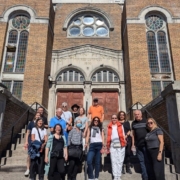
A large group turned out for our walk, led by dynamic guide Sharoni Sibony. As a relative newcomer to Canada, I was curious to learn about the Jewish history of this area, and happy that I would have Jewish peers with me during the experience.
Our tour started at the Kiever Shul, where Sharoni provided us with background information about Jewish immigration to Toronto and showed us the beautiful sanctuary. From there we walked to Nassau Street, to hear about the local Jewish bootlegger families who used to do business there. We learned that the son of one of the bootleggers was Sammy Luftspring, the featherweight boxing champion. We also visited Shoichet’s Alley, off Kensington Avenue, where families brought their live chickens to be slaughtered, now home to several colourful murals (see the photo). We noted various ways the market area has changed over the years, most notably the non-Jewish populations now predominant. Our final stop was outside the Minsker Synagogue (see the photo) and the old site of the Toronto Labor Lyceum. As we walked between stops I enjoyed chatting with other folks attending the tour.
Sharoni’s descriptions of the reasons people left Europe to settle here and the movement of the Jewish population through different neighbourhoods in the city tied in with my sense of being part of the story of Jewish migration. The tour made me curious to learn more about my own family’s relationship to Toronto, the city where my great-grandparents first lived when they came to North America and hence where my grandfather was born. I subsequently reached out to relatives and was able to find the house on Borden Street where they lived before moving to Detroit.
Sharoni had explained that although some of the old houses looked big, they often had many immigrants living in them together. I wondered who else might have lived in that house with my grandfather’s family.
Another aspect of the tour that intrigued me was learning about contributions that Jews made to non-religious community institutions such as the Toronto Labor Lyceum, the headquarters for some of the trade unions. Established by Henry Dworkin and Sam Easser, it also provided a place for social and cultural events. We learned that Henry Dworkin’s wife, Dorothy Dworkin, who was trained as a nurse and midwife, was a driving force behind the creation of Mount Sinai Hospital.
While Dorothy Dworkin was a caregiver in a very public way, at our HaTzipporim stage of life many of us are caregivers privately for children, spouses, aging parents, or some combination of those. Sandwiched between generations who need our support, we are sometimes referred to as the “sandwich generation.” With this in mind, we will be meeting with lawyer Felice Kirsh at Holy Blossom at 10:30 a.m. on Sunday, November 3 to explore the emotional, mental, physical, legal, and financial aspects of caregiving. We will learn from her expertise, share our own experiences, and support one another as we reflect on the varied aspects of this journey. Treats from Holy Blossom will be provided and all are welcome.
To register for the caregivers’ session, go to https://holyblossom.org/event/hatzipporim-empty-nesters-presents-lets-talk-about-caregiving/
Many of the historical sites and stories from our walk can be explored further at https://ontariojewisharchives.org.
HaTzipporim (Empty Nesters) is a peer group for Holy Blossom Temple members in late midlife. It meets roughly once a month, offering topical programming, Jewish religious and cultural events, and social gatherings. The topical sessions are designed to be relevant for the stage of life when many are in the “sandwich generation,” navigating transitions related to having young adult children and/or aging parents, or are looking towards career changes or next chapters. For more information, contact [email protected].

By: Anne Dublin
Sheila Smolkin (née Joyce) was born in Ottawa in 1945. Her parents were Walter Joyce and Mary Sedgewick Joyce. They both graduated from Victoria College, University of Toronto in 1940 where they majored in Math and Physics. Mary was one of only two or three women in her class at that time; Walter was a teacher who went on to become a principal at several high schools in Ottawa.
The oldest of four children, Sheila was raised in a United Church family. After high school, she moved to Toronto where she planned to study Household Economics at Victoria College, U of T. However, in 1963, this department became The Faculty of Food Sciences, a change that meant she could no longer live at Victoria College. Fortunately, University College allowed her to stay there for her first year. She obtained her BSc in Food Sciences in 1967.
Meanwhile, Sheila met Bob Smolkinon a blind date during her first year at UC. They continued dating until Sheila graduated. They got married that same year. The couple joined Holy Blossom and Sheila took classes there with Rabbi Michael Stroh from 1966 to 1967. She converted to Judaism—both because it was important to Bob and because she was attracted to the religion.
Sheila began a master’s program in nutrition at U of T and graduated with an MSc in 1969. However, she soon realized that she didn’t want to become a research scientist (and experiment on white rats!), so she began a new path and obtained a bachelor’s degree in library science the following year. Sheila got a job quickly. First, at the David Dunlop Observatory library; then in the Science and Medicine Library at U of T.
When Sheila had her first (of three) children in 1974, she decided to be a “stay-at-home” mom. By then, Bob had graduated from law school and was practising as a real estate lawyer.
Sheila wanted to become more involved with Temple. She answered an ad in the Bulletin for volunteers in the Sisterhood Library. She was gladly accepted and eventually became chair of the library committee. Because of her talent and commitment, she was then asked to be on the Sisterhood Board. One portfolio led to another until Sheila became President of Sisterhood from 1991 to 1993. Her outstanding leadership and organizational abilities were recognized. Sheila became a member of the Temple Board, then the Executive, and eventually “worked her way up” to becoming President of Temple (2000–2002).
That’s not all. In 1981, David Hart, who was chair of the Archives committee, asked Sheila to help celebrate Temple’s 125th anniversary. Of course, Sheila accepted the challenge! In Sheila’s modest and unassuming way, she states that she has been happy since that time to continue her work in the Archives. Not so long ago, she helped to organize Temple’s 150th anniversary!
Sheila continues to be active in the Archives and is also a regular at the Saturday morning Torah study. She feels extremely grateful for her involvement in Temple, for she asserts that Temple has helped her live a rich Jewish life. May her strength and commitment continue for many years to come!
Rosh Chodesh, meaning head of the month, is a holiday celebrating the arrival of a new moon. All genders are welcome to join Women of Holy Blossom and pray in solidarity with Israel’s Women of the Wall in sacred worship for 7:30 am Shacharit services (9:00 am on Sundays and statutory holidays), followed by a light breakfast.
Learn more & join us in sacred worship to celebrate Shelia Smolkin here
Rabbi Yael Splansky
After such a hard and heavy year, this High Holy Day season was particularly moving. Welcoming so many new members and seeing so many young families is evidence that the Jewish future is bright.
Temple President Phyllis Denaburg and Executive Director, Rachel Malach join me in wishing everyone another round of blessings for the new year and another round of thanks to the many people who contributed skill and precious time to make our twenty-five services so meaningful. At the risk of missing someone, here is evidence of how it really does take a village to bring our congregation together for prayer, contemplation, and celebration. (If we have inadvertently missed someone here or misspelled a name, first, please forgive us and let us know by contacted JoAnne at [email protected], so we can properly acknowledge you.)
Some have asked for copies of the Rabbis’ sermons. Follow this link. You can also revisit the High Holy Day melodies and Services by following this link. I am most grateful to my colleagues, Cantor David Rosen and Cantorial Soloist Lindi Rivers, Rabbi Sam Kaye, Rabbi Eliza McCarroll, and Rabbi Taylor Baruchel for bringing their whole selves to every bimah.
Our Torah and Haftarah Readers bring honour to our sacred texts. They practice for months to ensure every letter and every note elevates the occasion. Under the leadership of Cantorial Soloist Lindi Rivers they are:
Adam Sniderman, Adam Sol, Alberto Quiroz, Alexander Chris, Austin Warwick, Brenda Saunders, Camille Lisser, Chloe Fruitman, Cynthia Good, Daniel Abramson, Denise Gordon, Eli Sol, Ellen Lupu, Ellie Davidson, Ethan Steen, Harper Fine, Jeff Denaburg, Jesse Sol, Jill Kamin, Joan Garson, Lin Chow-Feldman, Lindsay McLean, Lisa Isen-Baumal, Lisi Tesher, Maddie Axelrod, Mike Morgulis, Milo Gould, Rob Steiner, Ruby Abramson, Susan Baskin, Ted Shafran
A Gabbai is like the stage manager, who ensures that our bimah rituals are performed inclusively and gracefully. Under the leadership of Jane Herman, Alberto Quiroz, and Rabbi Kaye our High Holy Day Gabbaim are:
Adam Cohen, Albert Oppenheimer, Alberto Quiroz, Avra Rosen, Eric Roher, Etienne Kaplan, Jane Herman, Joan Garson, Les Rothschild, Mark S. Anshan, Paul Kay, Phyllis Denaburg, Richard Feldman, Sam Sapera, Seanna Cohen, Susan Baskin
Our Ushers fulfill the essential mitzvah of hospitality, ensuring that everyone is safe and comfortable. Under the leadership of Gerry Prendergast, Bob Cooper, Rachel Malach, and Bridgedat Ramcaran, our High Holy Day Ushers are:
Arlene Roth, Arnold Englander, Aubrey Birenbaum, Avra Rosen, Bambi Katz, Bruce Arron, Carole Sterling, Chase Halliday, David Hertzman, David Sadowski, David Tartick, Etienne Kaplan, Fern Lebo, Gael Gilbert, Gail Goodman, Gary Goodman, James Karrel, Jeff Denaburg, John Morrissey, Judy Adler Lotin, Judy Winberg, Karen Kollins, Kathy Morrissey, Michael Ryval, Mitchell Toker, Paul Kay, Phyllis Denaburg, Rob Herman, Sheila Smolkin, Sue Rebick, Susan Mogil, Terry Yanowski, Elieen Tishauer
Holy Blossom Temple is extremely fortunate to have a wonderful Security Committee made up of members, led by Andrew Kirsh and Rachel Malach, with significant expertise in the area of security, both physical and virtual
Bob Cooper, Gerry Prendergast, Jonathan King, Simeon Olsberg, Richard Toker, Bridgedat Ramcaran
Congregant-physicians are on-call and strategically placed throughout our prayer spaces. In addition to the first responders on site, these devoted congregants are here, should anyone need medical attention. Under the leadership of Gerry Prendergast, they are:
Dr. Hannah Davis, Dr. Ira Bloom, Dr. Jacqui Willinsky, Dr. Jeffrey Meyers, Dr. Matthew Baron, Dr. Michal Coret, Dr. Rhonda Wilansky, Dr. Yoel Abells
Our Shofar Blowers call us to attention throughout the month of Elul and ring in the new year with kavanah (soulful intention). Under the leadership of Cantor Rosen they are:
Eli Sol, Howard Goodman, Jay Brodbar, Joel Lehman, Mark Weinstock, Michael Cole, Peter Dan, Rachel Malach, Robin Malach, Sam Mogil, Sam Sapera, Stephan Solyom, Stephen Tile, Steven Dan, Tal Maissner
Our Greeters are the first friendly faces you see as you approach Holy Blossom Temple. They answer our questions and point us in the right direction. Under the leadership of Sheila Weinstock, Caroline Ingvaldsen, and Rabbi McCarroll, our High Holy Day Greeters are:
Adam Shafran, Barbara Hodes, Daniel Wilson, Helena Fine, Joan Garson, Karen Mock, Olga Dunaevsky, Peter Dan, Phyllis Denaburg, Robin Mammot, Sandi Smith, Sharon Neiss-Arbess, Sheila Smolkin, Vlad Dunaevsky
Our Take-a-Break Rooms are popular destinations during our Family Services. These amazing teen leaders were there to greet them.
Emma Haras, Isaiah Gould, Nicole Polak, Sam Mogil
Hundreds of congregants greet the new year by participating in the bimah rituals. This takes two months of detailed planning. Coordination of Mitzvah-Honours, supported by JoAnne Bieman and Tali Katz, are thanks to these two extraordinary volunteers:
Judy Adler Lotin, Karen Abells
It is our custom each Yom Kippur afternoon to pause from our worship for many simultaneous Study Sessions. We are grateful to our many Teachers and hosts, who were supported by Rabbi McCarroll and Kate Wootton.
Ambassador Bob Rae, hosted by Hershell Ezrin and Barry Campbell
Ellie Tesher and Lisi Tesher, hosted by Dr. Bernard Goldman
Eric Beck Rubin, hosted by Mark Goodman
Justin Chow, hosted by Abby Snider and Lin Chow Feldman
Rabbi Shalom Schacter, hosted by Andrea Katz and Daniel Abramson
Sharoni Sibony, hosted by Mark Schlossberg
Wendy Melvin
Wendy Solomon, hosted by Susan Cohen
Independent Study in our Library, hosted by Sheryl Johnston
In addition to our Rabbis and Cantors, congregant-volunteers and professionals help to lead our services. Thanks to their talents and devotion, we are able to offer services designed for every life stage.
Elana and Les Hunter, Creative Collaborators for our Little Blossoms Services
Josh Nezon, Family Service and Little Blossoms Service Leader
Dr. Mark Weinstock, Family Service and Young Readers Service Leader
Ayla Smolash, Young Readers Service Leader
Temple Singers, under Cantor Rosen’s baton and supported by Iris Spitz
Susan Baskin, Karen Cohen, Ellen Cole, Susan Cohen, Anne Dublin, Vlad Dunaevsky, Olga Dunaevsky, Helena Fine, Denise Gordon, Barbara Grossman, Ron Hart, Caroline Ingvaldsen, Jill Kamin, Dana Lowi-Merri, Catherine Mayers, Sharon Smith-Miller, Shelley Miller, Lew Molot, Eva Ormut, Sylvia Papernick, Dena Perlmutar, Beth Roher, Joanne Roher, Paula Rosen, Shoshana Sage, David Sandler, Sandi Schafer, Saul Ship, Paula Warren, Sheila Weinstock
Special Vocal Appearances by:
Joel Glickman Rosen
Sarah Newstadt
Professional Choir and Musicians, under the direction of Jason Jestadt, pianist and Musician-in-Residence
Beth Silver, Paul Ormandy, Gordon Brown, Melody Bell, Shannon Halliwell, Andrea Ludwig, Jennifer McCallum, Gwyneth Sestito, Mark Wood-Salomon, David Yung, Nadia Adler
And finally, thanks to our amazing team of Holy Blossom professionals, led by our Executive Director, Rachel Malach. Because of them, all the pieces of the High Holy Day puzzle come together as one seamless whole.
Adrian Ramcaran, Amanda Luu, Amy Lester, Ari Iroanwusi, Bridge Ramcaran and our Security Team, Cindy Zimmer, Dalia Alalouf, Dante Thorne, Deanna Levy, Ela Paz, Ella Vatagsky, Iris Spitz, Jaivahn Johnson, JoAnne Bieman, Kate Wootton, Lindsay Mockler, Lisa Isen Baumal, Mark Hodgson, Marni Turner, Mercy Afuye, Neomi Offman, Pavel Gurvich and our Tech Team, Prakash Singh, Rebekah Lobosco Gilli, Sarina Shrestha, Shira Lester and our Kol Nidre Appeal Team of Leaders, Sophie Rivers, Tali Katz, Wendy Himmel

1950 Bathurst Street, Toronto, ON, M5P 3K9
(416) 789-3291
[email protected]
Emergency Funeral Contact
Cell: 416-565-7561

Founded in 1856, Holy Blossom Temple is Toronto’s first synagogue with a rich history of tradition and modernity in our religious and spiritual expression.