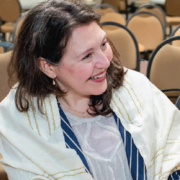
Women of Valour Series: Honouring Dalia Alalouf
Welcome to Rosh Chodesh Sivan on Sunday, May 17, at 9:00 am – All are welcome!
The Women of Valour Series is generously sponsored by Robert Lantos in memory of his mother Agnes Lantos z”l
Zodiac sign – Gemini (The Twins)
Sivan, the third month of the Hebrew calendar, reflects the spiritual power of the number three—seen in Moses, the third child, and the three-day preparation to receive the Torah.
This month, we celebrate Shavuot, commemorating the giving of the Torah at Mount Sinai over 3,300 years ago. Each year, we renew this sacred bond, likened by our sages to a wedding between G-d and the Jewish people.
The essence of Sivan is Tiferet—harmony and truth—a balance of justice and compassion, embodied by Moses and Aaron, and reflected in Gemini, the twins. The story of Ruth, read on Shavuot, reminds us of the courage to pursue a life of deeper purpose and truth.
Woman of Valour: Tribute to Dalia Alalouf
By Lesley Simpson
I interviewed Dalia in late March 2026, before my bat mitzvah in May. At that time, Dalia said, “I still can’t believe this honour, eshet chayil for rosh chodesh. I’m the luckiest person on earth to be able to do what I love the most, teaching and helping out.”
I first met Dalia when I joined the HBT Monday night Aleph Bet class in the fall of 2025.
I joined because I have an Olympian level of Jewish curiosity. I was not planning to have a bat mitzvah; however, when I heard about the opportunity to learn cantillation, my interest was piqued, and I was terrified. “We leave nobody behind,” Dalia told us. She mentioned that once she did have a student faint, but that her system was foolproof. We had to trust the process.
Dalia created a pedagogical system for cantillation. With each parsha, she underlined different phrases in different colours. Red, blue or green pencil indicated which trope to use. We were given a recording of the tropes. As I progressed, I earned the right to add another colour to my parsha, Leviticus 25 8-13. I kept the parsha in my purse. For an English speaker, this skill of cantillation is not easy because there is the visual pattern recognition required to recognize and pronounce the Hebrew, as well as trope melodies. To make it more daunting, the trope itself is not in the Torah parchment.
What is surprising about Dalia is that Hebrew is not her first language. She was born in Bacau, Romania, in 1948 and immigrated to Israel in 1959. Romanian was her first language. She and her family moved to Neharia, and she learned Hebrew in Kibbutz Eyn Dor. The move was difficult for her family. Her mother, who spoke many languages, worked at a restaurant to keep the family afloat financially. Dalia was eleven years old when she landed in Israel and had no Jewish background. Being Jewish in Romania had been a liability with systemic discrimination in many quarters of society, from school to government. Dalia remembers the hatred towards Jews she experienced within the school system, where Jews were not given the same opportunities as others. Jews were singled out and humiliated. Subsequently, in her family, Judaism skipped a generation.
Her own parents did not observe Jewish rituals or traditions (She did not attend her first Passover Seder until she met her husband Jack when she was 19 years old, and his family’s Seder unfolded in Ladino!) But before she met Jack and landed in Israel, a new world opened for Dalia, and she learned Jewish texts as well as the Hebrew language.
“I attended school, then high school; I worked hard to catch up with all the Bible, Talmud, and Israeli literature I had missed in my early years. I bet this is where my understanding, compassion and patience towards students—kids and adults—comes from, knowing how difficult, strange, new things are and competing with others. Then I proceeded to study in teachers’ college in Beit Berl, Kfar Saba.
Dalia lived in Israel for eight years, and on April Fool’s Day, she met Jack, her future husband. He had served in the Israeli Air Force and, upon his discharge, looked for work in Israel. There was no work. He had a sister who lived in Canada who sponsored him. He arrived on a Friday in 1967 after the Six-Day War, and on Monday, he was hired at De Havilland Aircraft Company. This August, the couple will celebrate their 59th wedding anniversary.
“Teaching was in my DNA. I was always surrounded by children and tutored many. It was my real passion.” Dalia worked at Beth Am, Beth Tikvah and Beth David synagogues, and then applied to Holy Blossom Temple, which has been her “second home” since 1971.
“What makes teaching adults different is that they have chosen to learn. They are not being forced. Each person learns differently…. Each person I come into contact with is a gem.”