

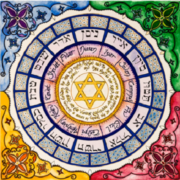
Zodiac sign: Aries, Attribute of the month: Speech, Letter: ה
The month of Nissan is referred to as Chodesh ha-aviv (month of spring). It is considered the first month of the Jewish calendar, the spiritual Rosh ha-shana and the month of Tishrei, which is considered the first month of the physical world. The month of Nissan is inspiring, and uplifting when nature and every living soul wakes up from hibernation. It signals renewal and hope. It is the month of double miracles as Nissan has two Nun letters (נ for Nes).
These are the miracles that G/d did to redeem us from slavery in Egypt.
The spiritual birthday of the world is in Nissan, Head of the Months, [ניסן]
Nissan in the Gematria equals two times [פה] mouth [(50+10+60+50)=170 = Nissan; 80+5= [פה] Peh ([פה] x 2 = 85×2 =170. The connection to the letter is “speech”, as we are to retell the story of Exodus from Egypt through the Haggadah. We celebrate the eight-day holiday from the 15 to the 22nd of Nissan (April 22-30) and following the rituals we experience the true spiritual freedom when after 210 years of being slaves G/d took us out of Egypt and we became superhuman and appreciated the power of nature reaching its zenith in the spring. It is through Pesach that we became a nation of priests (Am-Kohanim) therefore we became subjects of our King, G/d.
The limb of the month is the “right foot” because we have to make a quantum leap with the right foot, to start a transformation for 49 days from Pesach to Shavuot. Yehuda is the tribe of the month of Nissan as he is the King of the 12 tribes.
The permutation of this month is the four letters of G/d in the correct position יהוה as it is the first month of the year and this permutation can
be found in the book Psalms 96:11: “יִשְׂמְחוּ הַשָּׁמַיִם, וְתָגֵל הָאָרֶץ,” “Let the heavens be glad, and let the earth rejoice.” This verse reveals the energy of the month that brings joy and happiness in heaven and on earth.
In the interest of Rosh Chodesh, each month is a new beginning, each month brings new energy and we are revitalized. Chodesh in the Gematria equals 312 and the word G/d יהוה equals (10+5+6+5) 26 if we multiply 26 by 12 months of the year it equals 312, it signifies that G/d is with us every month. During the month of Nissan we must rejoice together, Heaven and Earth, the spiritual from G/d and the physical from Man and it reflects it in our wishes for each other “Chag Pesach kasher v’sameach” Kosher for the sake of heaven, and Sameach for our sake.
We must step into this month with the ‘Right’ foot, some people believe, we should be positive and act with Chessed during the first 12 days of the month and beyond as we then ‘plant’ positive roots for the entire year and renewal of our lives. Furthermore, living under the current anxious situation, I feel certain optimism that this month we could turn grief into joy and sorrow and pain into hope. Ken Yehi Ratzon!
by Teresa Quiroz, on behalf of Women of Holy Blossom Temple
Shacharit Service: Tuesday, April 9, 2024, 7:30 am ET, in-person or via Zoom at https://zoom.us/j/93902401402?pwd=dGlOR2dEcGs1RVc0OVFwdkFtOVo5UT09
password: 667580
For upcoming dates and why Rosh Chodesh is special for women see https://holyblossom.org/rosh-chodesh/
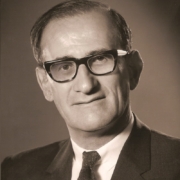
By Ruth Ellen Greenwood, member of Holy Blossom Temple Archives Committee
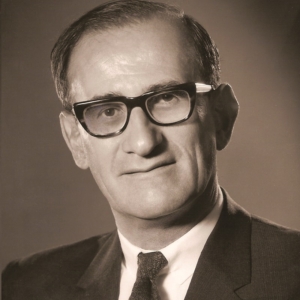 Heinz Warschauer was born in 1913 in Berlin, Germany and educated in public school and university there. He studied under Rabbi Leo Baeck and was a leader of the German Jewish Youth Movement of Berlin. Political journalism and teaching interested him all his life. In 1938, following Kristallnacht, he was interned in Buchenwald concentration camp. In 1939, he managed to get to England, and from there to Canada in 1940. Ironically, he was sent to an internment camp in Sherbrooke, Quebec as a German enemy alien.
Upon his release, Heinz began his studies at the University of Toronto where he earned a Masters Degree in Modern History and a Bachelor of Social Work. Starting as a part time teacher at Holy Blossom Religious School, Heinz became the full time Director of Education in 1947, a position he held until his retirement in 1976. Among his major contributions to Jewish education were curriculum development and the use of group work in Religious School and Adult Education. Heinz also created a Post-Confirmation Program which included a teacher training program and a club leadership program. He wrote a comprehensive account of the history of Holy Blossom Temple, and he authored the grade 9 Religious School syllabus of UAHC (now URJ).
In 1960, Heinz was the first Canadian elected as President of the National Association of Temple Educators. From 1967 to 1976, he was member of the Commission on Jewish Education of the Reform Movement. A member of the faculty of NFTY (National Federation of Temple Youth), Heinz was made a lifetime member in 1971. He also inaugurated camp weekends for Junior and Senior High School students and encouraged them to go to the Reform Camps in the United States prior to the establishment of Camp George in Muskoka, Ontario. Heinz was an ardent Zionist and maintained a lifelong interest in Middle Eastern Affairs.
He was always Heinz to everyone – never Mr. Warschauer – just Heinz, and we all knew who we were talking about. He was a unique and unforgettable individual who left a profound and lasting impact on all who studied and worked with him.
As he explained in his own words, “I am a teacher, a group worker, but not specifically a religious educator . . . I would develop a ‘Centre’ for our children as a proper group work agency . . . I would concern myself with the children as people rather than merely vessels to be filled with knowledge.”
He told the Confirmation Class of 1961, “. . . religion provides for constant challenge and assurance through its ‘seasons of gladness,’ its holy days, and its call to learning. It also provides for fellowship, for Judaism is not the possession of the hermit, but of the ‘Chevra’, the group, the brotherhood, which experiences, learns, suffers at times and eventually rejoices – together! ‘Hinnay Mah Tov Umah Na-eem!’”
When Heinz retired in 1976, Joe Kronick z”l wrote, “I probably learned more from him about how to work with people, how to sidestep conflict while at the same time ‘diving in’ head first. There was no compromising on the quality of the educational process . . . He and everything he touched have enjoyed a seal of quality approval . . . the Young Couples Club, Adult Education, Experimental Programs, the Youth Activities Program, All-Day Blitzes, and the placement of students from the School of Social Work. In essence, anything that touched upon the growth and change and identification of people with the Temple and all that it stood for, were part and parcel of Heinz’s driving energy.”
Rabbi Plaut z”l wrote about Heinz, “ To me he was not only unforgettable, he was also inspiration, support, and best of all a friend. . . . He was an irascible bachelor and a passionate educator and was often totally unpredictable. . . . He questioned and taught his students to question. He considered social commitment and action an ineluctable part of the religious quest. He believed in standards – and once the curriculum was set he demanded of his students that they achieve its goals. . . . He was a master teacher. For him there were no children that mattered, there was only the child. Teachers en masse didn’t count, but the individual teacher did. He was a historian at heart: the knowledge of one’s roots was essential to him and he loved to teach history. . . when in Germany, he was interned because he was a Jew and in England because he was a German. The double tension deeply affected his later outlook on life and made him doubly committed to the exploration of his identity and the firming up of the commitment to which he gave his best years. . . The thousands who not only respected him but considered him their spiritual mentor bear vivid testimony to the possibility of teaching as one of the greatest professions.”
I was fortunate to reap all the benefits of being a student at Holy Blossom Religious School when Heinz was the Director of Education. After Confirmation, I enrolled in his student teacher training program. Heinz had enough faith in me to allow me to split the Thursday afternoon teacher training seminars with my practice schedule for the Oakwood Collegiate Senior Orchestra. I left practice half an hour early and arrived half an hour late for the seminar. And because Heinz believed in me and validated my commitment to both activities, I became a successful teacher and enjoyed a long career in the best profession there is – preparing young individuals to take up their responsibilities when they become the adults of our world. Heinz always saw the individual whether a student, a student teacher, or a teacher. He always encouraged group work as a method for achieving the best results whatever the project. Heinz had no children and no family: the students of Holy Blossom Religious School were his children, and the members of Holy Blossom Temple were his family. May his memory forever be for a blessing.

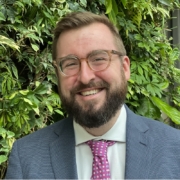
Last week the newly formed advocacy committee at Holy Blossom Temple reached out to our congregation. We asked you to make your voices heard regarding Opposition Resolution 658. As you are likely aware, Parliament passed this non-binding resolution on Monday evening. Some community partners see the passing of the resolution as an insult to the Canadian-Jewish community, a reminder that in the nationwide game of politics, we are vastly outnumbered. Other voices see the last-minute removal of the most extreme element of the resolution, the immediate and unconditional recognition of a Palestinian state, as a victory.
The answer likely lies in the middle. As Judaism teaches us again and again, these and these can both be true.
In moments like this, when our community comes together but the reach of our influence is unclear, it is more important than ever to remain steadfast. It is also vital to recognize and appreciate those who heed the call.
Then let me say, thank you! Thank you to our members who answered the charge and made their desires clear to our elected officials. Thank you for reaching out to members of parliament digitally, over the phone, and through the CIJA portal. Together with Jewish communities across the country, we generated more than 900,000 contact points with members of parliament. It made a difference, and you made a difference.
This weekend is our holiday of Purim. The Megillah has many messages, but one of the timeliest is that the decrees of government are not always just. Esther must reveal herself, take a stand, and fight for her people in the halls of power. Even when she is successful, her work is not over. In the final chapters of the Megillah, even after Haman is defeated, Esther must organize and continue to lead the Jewish people out of danger.
As it was in her day, so it is in ours. No matter how we view the outcome of Mondays vote, the work of Jewish Advocacy is not over.
In addition to our Purim celebrations, I want to highlight an important program, and a vital next step in our Advocacy work, that is happening next week. Dahlia Lithwick, Tiffany Moller, Guila Benchimol, Megan Stephens and Rabbi Yael Splansky will be leading a roundtable conversation at 7:30 pm on Wednesday, March 27th. This powerful evening will address the ongoing fight for justice and recognition regarding the sexual violence that Israelis experienced on October 7th. You can register here.
This week we need Purim, and its eternal message of hope, joy, resilience, and advocacy more than ever.
ליהודים היתה אורה ושמחה וששן ויקר (Esther 8:16)
The Jews enjoyed light and gladness, happiness, and honour.
So may it be for us as well, swiftly and in our day.
Chag Purim Sameach.


By Michael Cole
In 1943, at the height of World War Two, two people came to Holy Blossom who would hugely influence the direction the Temple would take in the post-war years, the years of greatest growth in its history.
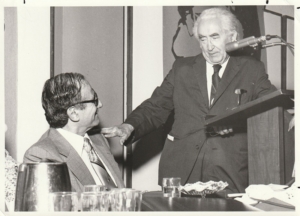
Rabbi Feinberg gives words of wisdom to Heinz Warschauer at the latter’s retirement dinner in 1976.
Rabbi Abraham L. Feinberg and Heinz Warschauer came from very different backgrounds. Rabbi Feinberg was the son of a poor Orthodox chazzan from Lithuania. He grew up in a small coal mining town on the Ohio River. Heinz (as he was known to young and old) was the son of a physician and grew up in Berlin. They each had a checkered and colourful career before coming to Holy Blossom. And they each possessed a colourful and memorable personality.
Together, Rabbi Feinberg and Heinz Warschauer made Holy Blossom Temple, and its Religious School, into an iconic institution in Toronto and among Reform synagogues worldwide.
Rabbi Feinberg made late Friday night services the cornerstone of our worship, and he made music and a cantor central to these services. Later, he instituted daily services. He made Bar Mitzvah, along with Confirmation, an important rite of passage and introduced the Bat Mitzvah celebration to our congregation.
Heinz Warschauer, who soon became Director of Education, instituted a rigorous teacher training program into our Religious School and undertook extensive development of its curriculum. He encouraged students to attend the newly-established Reform camps in the United States.
Both Rabbi Feinberg and Heinz were passionate Zionists who believed that Israel was a central part of our Jewish identity.
Over the next several weeks, we will explore in more detail the lives of Rabbi Feinberg and Heinz Warschauer in this column and in our Atrium display cases. We look forward to remembering these two gentlemen eighty years after their arrival in Toronto.
If you have any items of archival interest that you wish to donate, please email us at [email protected].
You may wish to visit the Archives Committee displays at the far end of our atrium as well as the Living Museum display by the elevator.


1950 Bathurst Street, Toronto, ON, M5P 3K9
(416) 789-3291
[email protected]
Emergency Funeral Contact
Cell: 416-565-7561

Founded in 1856, Holy Blossom Temple is Toronto’s first synagogue with a rich history of tradition and modernity in our religious and spiritual expression.