


A Dream Comes True
By Bambi Katz
For many years I have dreamt of taking my 3 adult children to Poland. I wanted them not only to know where they came from, but to see and feel it for themselves. My parents were each born in a different shtetl not far from Lublin. They emigrated to Toronto as a couple in their early 20s – first my father in 1928, with my mother following soon after in 1929.
Last month my dream became a reality when my grown children and I travelled to Poland together. My oldest son Alan, who lives in Vancouver, met my son Garry, daughter Karen, and me in Warsaw, where our journey began. Warsaw is now a lovely European city rebuilt after the Nazi bombings, followed by Communist control until 1989. Three highlights stand out for me.
First was our visit to the POLIN Museum, which is an excellent museum that outlines the history of 1000 years of Jewish life in the Polish Commonwealth, before the land was divided into smaller countries. We learned how and why Jews came to live in the Commonwealth more than 500 years ago. They settled in hundreds of small towns we know as shtetlekh (Yiddish plural for shtetl), and by the start of World War II, the Jewish population grew to three and a half million in Poland alone.
Second, we walked the area that had been the Warsaw Ghetto, where 400,000 Jews were crammed into inhumane conditions before facing death, either in the ghetto or Treblinka Extermination Camp.
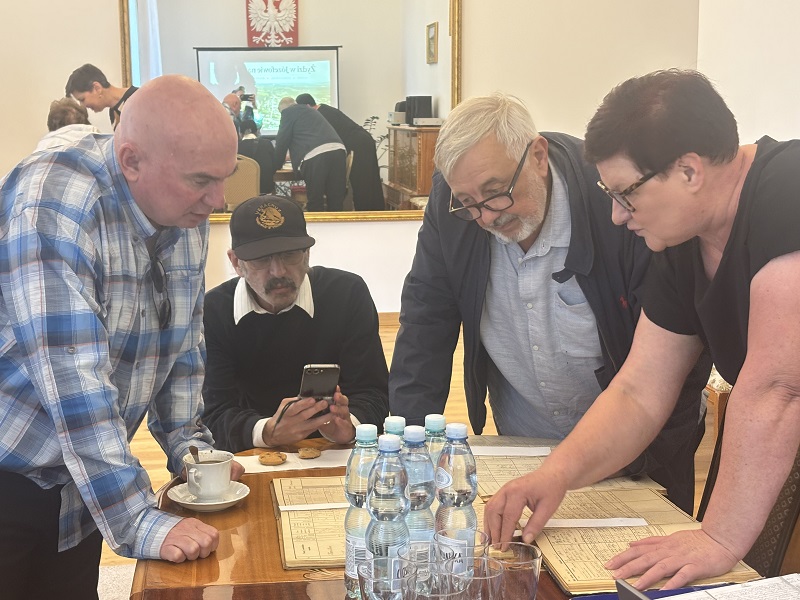
Third, we visited the Jewish Historical Institute where we met a researcher who helped us search records of our family and helped us gather new information. We were fascinated by how the Polish government kept extremely detailed birth, death, and marriage records written in Russian prior to 1915, then in Polish thereafter. With modern technology, the information was translated almost instantaneously. We found my father’s birth certificate, learned that my grandfather was a shoemaker, and even uncovered the address where he lived in Lublin that we had not known before.
The heart of our trip was a 3-day excursion to Lublin and the 2 shtetlekh, Leczna, my mother’s home until she left for Canada, and Jozefov Nad Wisla, where my father was born and lived until he was 8 years old, before moving to Lublin during the First World War. We were so fortunate to find a wonderful guide to help us with our journey. Aside from escorting us, he prepared for our visit in advance and set up numerous meetings for us with local officials. In addition to being our chauffeur, he translated our meetings and helped us navigate our visits.
Our first stop was Jozefov, where we were welcomed by the mayor and deputy mayor in their municipal building. A local librarian presented a PowerPoint and a video of the history of Jewish life in the shtetl. We learned that the Nazis liquidated the Jews to a ghetto in a neighbouring town, and from there they were all taken to Sobibor. Very little evidence of Jewish life remains, although we were able to see where the synagogue once stood. We were then brought to the Jewish cemetery, which is completely covered by overgrowth. One lone tombstone remains, leaning over almost to the ground. Alongside the cemetery is a huge apple orchard. The teacher in me couldn’t resist pointing out to my kids why we Ashkenazi Polish Jews eat apples and honey and apple cake on Rosh Hashanah and charoset made with apples for Pesach.
Our visit to Leczna was equally as welcoming, as we were greeted by the local librarian and her assistant. Remarkably, the shtetl’s synagogue is still standing and currently being reconstructed into a new library. The construction crew stopped their work so that we could go inside. The Aron HaKodesh and the Bima are still there and cannot be removed by the law of the Union of Jewish Communities in Poland, and so are being incorporated into the new design. We could even see where the women’s section of the synagogue stood at the back. We learned that most of the funding for the reconstruction comes from the European Union.
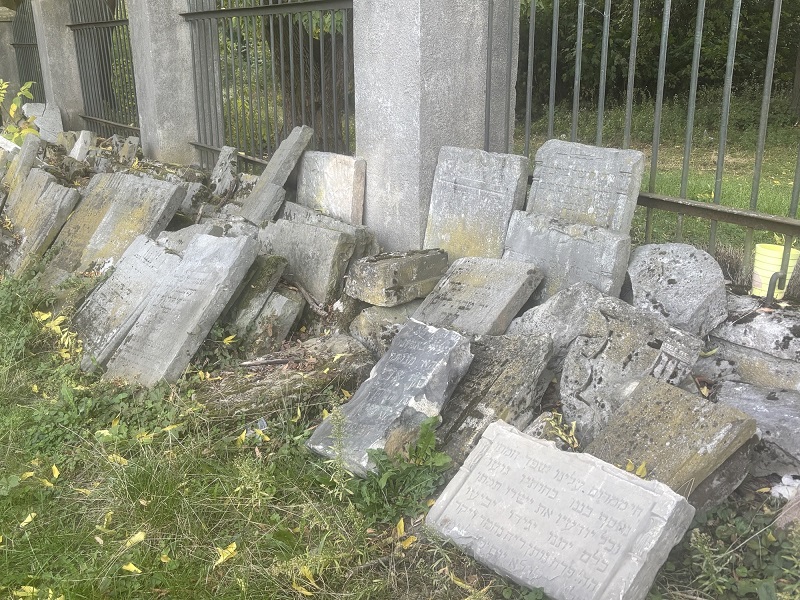
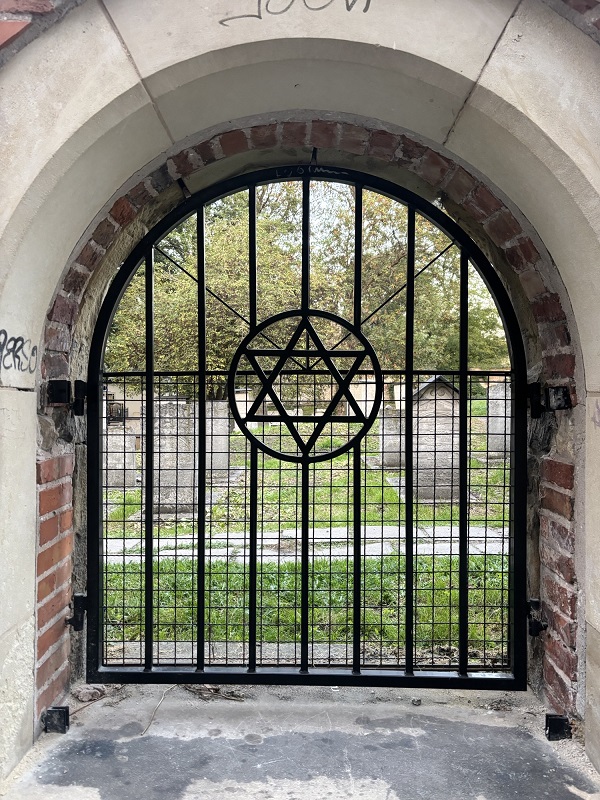
The story of the Jews under the Nazis in Leczna was traumatic. My mother lost her entire family, siblings, nieces and nephews, as well as her extended family in Leczna. The Jews were rounded up, about 1000 were shot in one day on the bank of the river, and the others were taken to Sobibor. I don’t know how much information my mother knew, but I feel that she never fully recovered from the trauma. Today, a monument stands with about 100 names of the 1000 who were shot. We were both horrified and amazed to find the name of someone from our family tree on the monument. In the same area, we saw pieces of broken tombstones from the Jewish cemetery, enclosed with a fence, also in memory of the Jews who lived there. Amazingly, our hosts know the words metsevahs (tombstones) and cheder (Hebrew school). We were very warmly received with hugs and apple cake baked by the librarian in our honour. We concluded our visit to Leczna by visiting the Jewish cemetery, also covered with overgrowth, where my grandparents would have been buried.
Our visit to Majdanek Concentration Camp began with a meeting with an historian. While our family members were not sent to Majdanek, the historian was able to find evidence of the life and death of my mother’s niece, whom we now know died in a neighbouring ghetto when she was 25 years old. Her story is too brutal to repeat. We walked through the camp on our own, along with other visitors, some in groups, including young Israelis, trying to absorb the brutality.
Hundreds of years ago, Lublin was a place of great Jewish learning with Yeshivot and learned Rabbis. Today it houses 5 universities, including a medical school. The greatest yeshiva has been turned into a hotel where we stayed, on the same street where my father attended school as a young boy. The beautiful sanctuary remains and is used by the local community, mainly Chabad and Satmar Jews. We found the buildings of the family addresses we had, with only some buildings remaining. We walked through the Grodzka Gate, the Jewish Gate, and saw many plaques written in Polish and Yiddish dedicated to the memory of the Jews. Before the Holocaust, about one-third of Lublin’s population was Jewish.
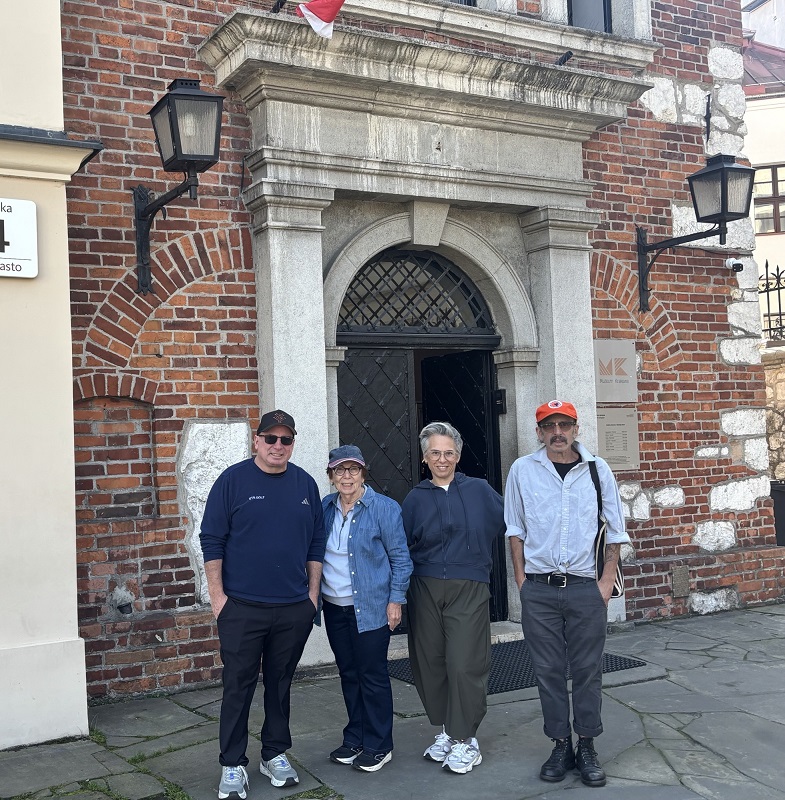
The final stop on our trip was Krakow, a beautiful city with the Jewish area called Kazimierz still intact. We spent a day on a Jewish walking tour and learned that Hitler did not bomb Krakow, as he wanted to keep it a German city. The Jews of Krakow were rounded up into a ghetto, then deported to either Belzec extermination camp or Plaszow labour camp. I loved walking through Kazimierz. We visited the Krakow JCC, a Yiddish/Hebrew bookstore, saw the many synagogues still standing, and ate in a number of Jewish-style restaurants. The main square of Krakow is equally very old and beautiful, with an amazing history. It even had a Zara store where Karen and I managed to shop. On our final day, Karen and I visited Auschwitz, not an easy way to end the trip, but we felt that it was our responsibility to bear witness as descendants of Polish Jews.
Eleven days of travelling together and exploring our Jewish roots was definitely a dream come true.